AIPIF™: AI Prioritisation & Investment Framework
A structured decision framework that helps organisations evaluate, score and rank AI opportunities before committing resources to pilots, implementation and financial modelling.
Contact FINWISERRMost Organisations Do Not Have an AI Problem. They Have an AI Prioritisation Problem.
Artificial Intelligence has moved beyond experimentation and become a strategic priority for boards and executive leadership teams.
Across industries, organisations are exploring how AI can automate processes, improve customer experiences, strengthen decision-making, reduce operating costs and unlock new sources of revenue.
The challenge, however, is rarely a shortage of AI ideas. In most organisations, the opposite is true.
Marketing teams want AI-powered personalisation. Finance teams want predictive forecasting. Operations teams want intelligent automation. Customer service teams want chatbots and virtual assistants. Leadership teams want enterprise-wide AI transformation.
Every department sees opportunities, but organisational resources, budgets and implementation capacity remain limited.
What Is AIPIF?
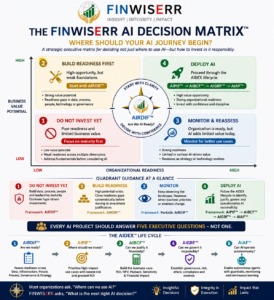
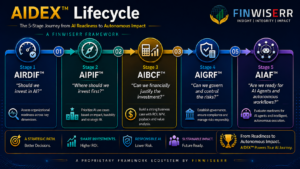
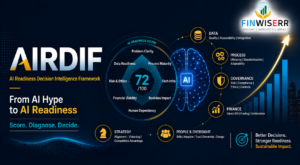
AIPIF is Stage 2 of the AIDEX AI Decision Excellence Suite. It converts AIRDIF readiness outputs into a structured process for prioritising AI use cases.
- Evaluate shortlisted AI opportunities across six strategic dimensions
- Calculate a weighted Priority Score for each use case
- Identify initiatives for immediate investment or pilot programmes
- Highlight use cases that require improvement
- Defer or reject lower-priority opportunities
- Create a clear AI investment shortlist for leadership decision-making
The result is a focused, evidence-based view of where the organisation should invest first.
Why AI Use Case Prioritisation Matters
Many AI programmes struggle before implementation even begins. The problem is not always the technology — it is often the selection of the wrong use case.
Organisations may invest in projects that appear innovative but have limited strategic relevance, weak data foundations or excessive implementation complexity.
- Pursuing low-impact AI use cases
- Selecting technically impressive but commercially weak solutions
- Underestimating integration and implementation requirements
- Ignoring data availability or data quality limitations
- Overlooking organisational and operational readiness
- Failing to account for regulatory or reputational risks
- Taking every AI idea directly into detailed financial modelling
- Allowing departmental influence to replace objective evaluation
AIPIF introduces discipline, consistency and evidence-based decision-making before budgets are committed.
The Six Core Dimensions of the AIPIF™ Framework
Each dimension is assessed through eight structured questions scored 1 to 5, then combined into a weighted AI Priority Score.
Strategic Value
How strongly the initiative aligns with organisational priorities and creates meaningful business impact. The highest-weighted dimension, ensuring viable projects are also strategically worthwhile.
Implementation Ease
How practical the initiative is to deploy — technical complexity, integration, resources, partners, pilot feasibility, change management and dependencies.
Data Readiness Fit
Whether reliable, accessible and sufficient data exists to support the use case — availability, quality, structure, governance and privacy. Linked to AIRDIF results.
Risk Profile
Whether legal, regulatory, ethical, privacy, cyber and reputational risks are understood and manageable, including model bias and human oversight.
Time to Value
How quickly the use case can deliver measurable benefits — pilot feasibility, speed to production, adoption and clear performance indicators.
Scalability Potential
Whether the use case can expand across departments, processes, markets and customer groups while reusing data, models and infrastructure.
Why Financial Return Is Not a Scored AIPIF Dimension
Financial Return is intentionally excluded from the six scored dimensions — a deliberate design decision. AIPIF is an AI prioritisation framework, not a detailed financial justification model.
At the prioritisation stage, organisations should first determine whether an AI use case is:
- Strategically relevant
- Technically achievable
- Supported by suitable data
- Operationally realistic
- Manageable from a risk perspective
- Capable of delivering value within an appropriate timeframe
- Scalable beyond its initial application
Once validated, the strongest use cases proceed to AIBCF for detailed financial analysis. This sequencing prevents building financial models for projects that should have been eliminated during strategic evaluation.
How the AIPIF Prioritisation Process Works
Complete AIRDIF Assessment
Import AIRDIF readiness scores to establish context and assess data readiness for each use case.
Register AI Use Cases
Document each opportunity: business problem, application, function, beneficiaries, evidence and dependencies.
Score Each Use Case
Evaluate against 48 structured questions across the six dimensions on a 1–5 scale.
Review Priority Ranking
Compare weighted scores, investment tiers and dimension-level results to identify leaders and gaps.
Progress to AIBCF
Move top-ranked use cases into AIBCF for financial modelling, ROI and board-level approval.
The Five AIPIF™ Investment Tiers
Each AI use case is automatically assigned to one of five investment tiers based on its weighted Priority Score.
| Tier | Score | Classification | Recommended Action |
|---|---|---|---|
| Tier 1 | 86–100% | Immediate Investment | Proceed to AIBCF and board approval |
| Tier 2 | 71–85% | Priority Pilot | Launch pilot and develop business case |
| Tier 3 | 56–70% | Conditional | Address gaps and reassess |
| Tier 4 | 36–55% | Deferred | Revisit in 6–12 months |
| Tier 5 | 0–35% | Rejected | Redirect resources elsewhere |
Key Outputs of AIPIF
- AI Opportunity Priority Ranking Dashboard
- Weighted Priority Score for each use case
- Five-tier investment classification
- Dimension-level diagnostic scores
- Identification of strategic, technical and operational gaps
- AIRDIF™-linked Data Readiness context
- Prioritised list of use cases for pilot programmes
- AIBCF™ hand-off list for Tier 1 & Tier 2 opportunities
- Executive decision-support insights
- Evidence-based documentation for AI investment decisions
Who Should Use AIPIF
- CEOs and executive leadership teams
- Boards and investment committees
- CIOs, CTOs and Chief Data Officers
- Chief AI Officers
- Digital transformation & AI strategy leaders
- Innovation teams
- Finance and corporate strategy teams
- Business analysts
- Technology and management consultants
- Advisory firms
- Private equity and investment teams
- Government and public-sector organisations
Why AIPIF Matters
AI investment decisions are becoming more important, more complex and more expensive. Organisations cannot pursue every AI opportunity — nor can they afford to overlook initiatives that create meaningful strategic value.
The solution is not to move every idea directly into implementation or financial modelling. It is to introduce a disciplined decision process that identifies the strongest opportunities first.
- Compare AI use cases consistently
- Reduce subjective investment decisions
- Focus resources on high-potential opportunities
- Identify data and implementation gaps
- Balance quick wins with long-term strategic investments
- Avoid unnecessary financial modelling
- Create a defensible AI investment pipeline
- Improve executive confidence in AI decisions
Successful AI transformation does not begin with purchasing technology. It begins with choosing the right problems and prioritising the right opportunities.
Part of the AIDEX™ Suite
| # | Framework | What It Measures |
|---|---|---|
| 1 | AIRDIF | Are we ready for AI? |
| 2 | AIPIF | Where should we invest first? |
| 3 | AIBCF | Can we financially justify the investment? |
| 4 | AIGRF | Can we govern and control the risks? |
| 5 | AIAF | Are we ready for AI agents and autonomous workflows? |
About Finwiserr
Finwiserr is a specialist advisory firm helping corporate and technology leaders make smarter decisions at the intersection of finance, strategy and emerging technology.
AIPIF came from watching the same thing happen too many times: a leadership team completes a readiness assessment, identifies a dozen AI opportunities, and then spends three months in circular debate about which one to pursue.
We built the framework that ends that conversation.
Book an AIPIF Results Review
Completed your assessment and want a second pair of eyes on the results? Speak with a Finwiserr consultant to walk through your Priority Rankings, validate your tier classifications, and agree on which use cases are ready to move forward.
Discuss Your AI Requirement contact@fin-wiser.comAIPIF · AI Prioritisation & Investment Framework · Stage 2 of the AIDEX Suite
Identify. Score. Rank. Prioritise.