The FINWISERR AI Decision Matrix™
Making Better AI Investment Decisions
Artificial intelligence has become one of the most discussed topics in boardrooms worldwide.
Organizations are being encouraged to automate faster, implement generative AI, deploy AI agents, and digitally transform before their competitors. However, amid this pressure to adopt AI, one fundamental question is often overlooked:
Are we making the right AI decision at the right time?
At FINWISERR, we believe successful AI transformation is not simply about adopting the latest technology. It is about making informed, financially sound, and well-governed decisions.
That belief led us to develop the FINWISERR AI Decision Matrix™, an executive AI decision framework that helps organizations determine:
- Whether AI should be prioritized
- Where AI can create meaningful business value
- Whether the organization is ready to implement AI
- What steps should be taken before deployment
- How AI investments should be evaluated and governed
The framework helps leaders move beyond AI enthusiasm and focus on the next right decision.
Why Most Organizations Ask the Wrong Questions About AI
Many AI conversations begin with questions such as:
- Which AI tools should we purchase?
- Which business processes should we automate?
- Should we deploy AI agents?
- Which large language model should we use?
- How quickly can we implement generative AI?
These questions are important, but they should not be the starting point.
Before selecting technologies or launching pilots, organizations should first determine whether the proposed AI initiative addresses a meaningful business problem and whether the organization is prepared to implement it successfully.
AI initiatives often struggle because of issues such as:
- Poor data quality
- Unclear business objectives
- Fragmented processes
- Weak executive alignment
- Limited governance
- Inadequate implementation capabilities
- Insufficient financial justification
Technology is therefore only one part of AI success. Decision quality, organizational readiness, governance, and financial discipline are equally important.
What Is the FINWISERR AI Decision Matrix™?
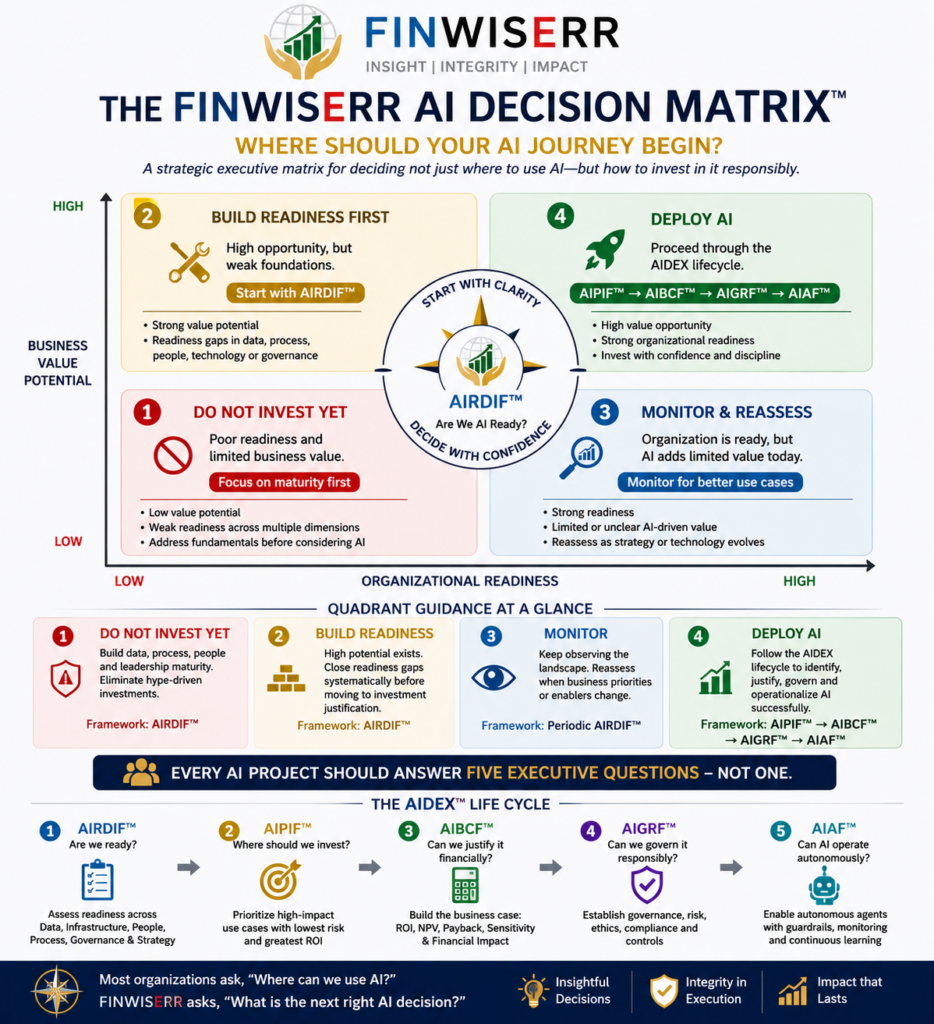
The FINWISERR AI Decision Matrix™ is designed to help executives assess AI opportunities using two critical dimensions.
1. Business Value Potential
This dimension evaluates whether the proposed AI initiative can create meaningful strategic, operational, or financial value.
It considers questions such as:
- Does the initiative solve a clearly defined business problem?
- Can it improve revenue, efficiency, productivity, or customer experience?
- Does it support the organization’s strategic objectives?
- Is the expected value significant enough to justify investment?
- Can the anticipated benefits be measured?
2. Organizational Readiness
This dimension assesses whether the organization has the capabilities and foundations required to implement AI successfully.
It considers areas such as:
- Data quality and accessibility
- Process maturity
- Leadership alignment
- Technology infrastructure
- Governance and risk management
- Internal AI capabilities
- Change management readiness
- Financial and operational capacity
The intersection of business value and organizational readiness creates four strategic paths.
The Four Quadrants of the FINWISERR AI Decision Matrix™
Quadrant 1: Do Not Invest Yet
When both business value and organizational readiness are low, AI should not be the immediate priority.
Organizations in this quadrant may have:
- Poor-quality or inaccessible data
- Undefined business objectives
- Fragmented or inconsistent processes
- Limited leadership alignment
- Weak internal capabilities
- AI initiatives driven primarily by market hype
In this situation, purchasing additional AI tools is unlikely to solve the underlying problems.
The more appropriate strategy is to improve operational maturity, strengthen data foundations, clarify business priorities, and establish leadership alignment.
Sometimes, the smartest AI investment decision is choosing not to invest yet.
Quadrant 2: Build AI Readiness First
This is where many organizations currently find themselves.
The potential business opportunity is significant, and leadership understands the possible benefits of AI. However, the organizational foundations required for successful implementation are not yet in place.
Common characteristics include:
- Promising AI use cases
- Weak data readiness
- Limited AI skills and capabilities
- Inadequate governance
- Unclear ownership
- Poorly defined implementation processes
- Limited change management readiness
For organizations in this quadrant, readiness is more valuable than speed.
Before committing substantial capital to AI technologies, they should invest in becoming AI-ready. This may involve improving data quality, redesigning processes, developing governance structures, building internal capabilities, and establishing clear executive accountability.
Quadrant 3: Monitor and Reassess
Not every AI opportunity requires immediate investment.
Some organizations may possess strong technology infrastructure, mature leadership, reliable data, and effective governance. However, a particular AI initiative may not currently offer sufficient strategic or financial value.
In these situations, organizations should avoid implementing AI simply because the capability exists.
Instead, they should:
- Monitor technological developments
- Reassess changing business requirements
- Track implementation costs
- Evaluate market and regulatory developments
- Review the opportunity periodically
Technology evolves, business priorities change, and implementation economics improve over time.
In some cases, waiting is a more disciplined strategy than rushing into an investment with limited value.
Quadrant 4: Deploy AI
Organizations in this quadrant have both strong business value potential and a high level of organizational readiness.
They typically possess:
- A clearly defined business problem
- Strong executive sponsorship
- Reliable and accessible data
- Mature operational processes
- Appropriate technology infrastructure
- Governance and risk management capability
- Financial justification
- Clear accountability for implementation
For these organizations, AI can become an accelerator rather than an experiment.
However, deployment should still follow a structured process. AI investments should be prioritized carefully, supported by robust business cases, governed responsibly, and monitored against measurable outcomes.
Beyond the AI Decision Matrix
The FINWISERR AI Decision Matrix™ helps an organization understand its current position and determine the most appropriate strategic path.
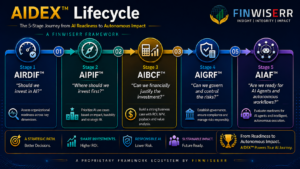
Once that position is clear, the organization can progress through the AIDEX™ Decision Excellence Journey.
AIDEX™ provides a structured methodology for moving from AI readiness to prioritization, financial justification, governance, and autonomous execution.
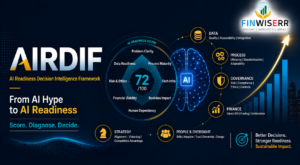
Stage 1: AIRDIF™ — AI Readiness & Decision Intelligence Framework
Executive question: Are we ready for AI?
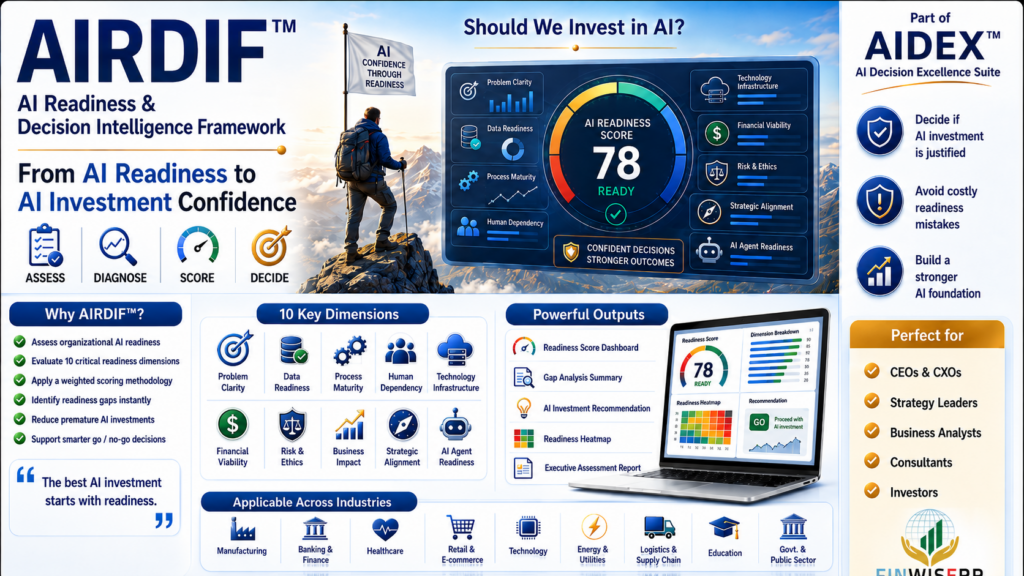
AIRDIF™ evaluates whether the organization has the necessary foundations to implement AI successfully.
The assessment considers areas such as:
- Strategic alignment
- Data readiness
- Process maturity
- Leadership commitment
- Technology capability
- Governance
- Risk awareness
- Organizational capacity
The purpose is to identify readiness gaps before significant AI investments are made.
Stage 2: AIPIF™ — AI Prioritization & Investment Framework
Executive question: Which AI opportunities deserve investment?
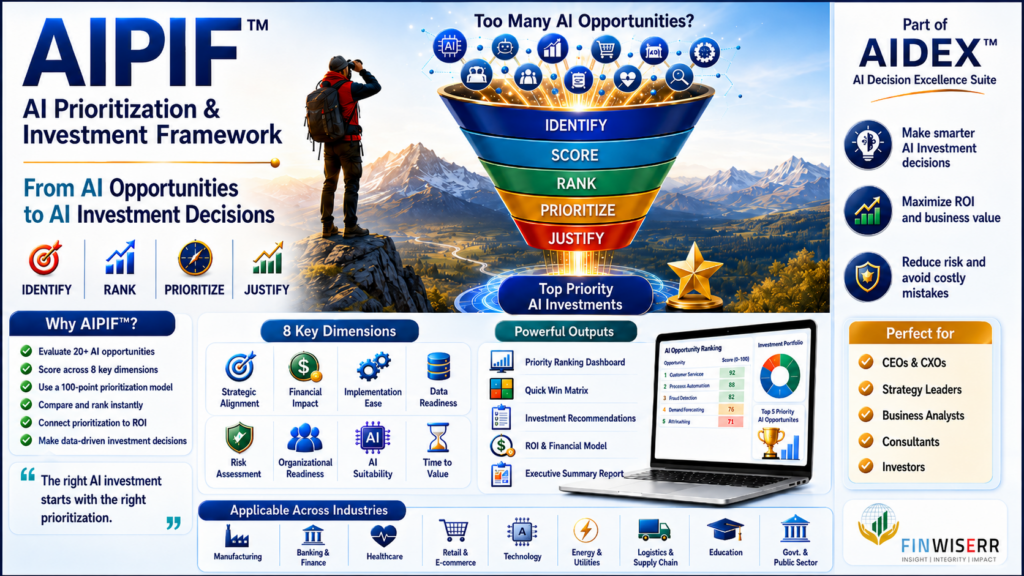
Not every AI opportunity creates equal value.
AIPIF™ helps organizations compare and prioritize AI initiatives based on factors such as:
- Strategic impact
- Expected business value
- Implementation feasibility
- Data availability
- Operational complexity
- Investment requirements
- Risk exposure
- Time to value
This enables management teams to direct capital and resources toward opportunities with the strongest strategic and financial potential.
Stage 3: AIBCF™ — AI Business Case Framework
Executive question: Can we financially justify this investment?
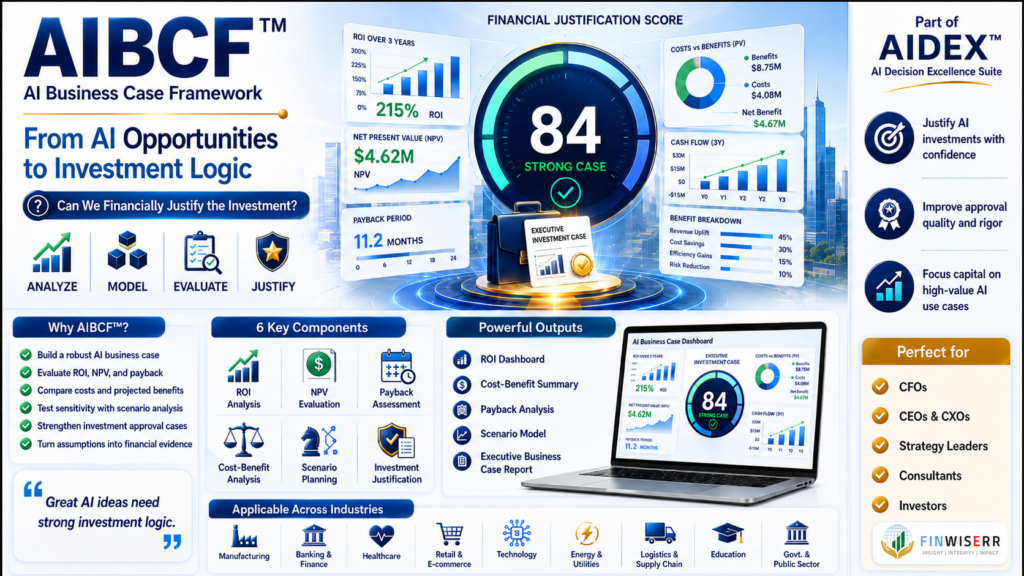
An AI initiative should not proceed solely because it is technically achievable.
AIBCF™ helps organizations develop a structured financial case covering:
- Implementation costs
- Operating costs
- Revenue enhancement
- Cost savings
- Productivity benefits
- Return on investment
- Net present value
- Payback period
- Financial sensitivities
- Downside scenarios
A robust AI business case gives executives greater confidence when approving investments and allocating capital.
Stage 4: AIGRF™ — AI Governance & Risk Framework
Executive question: Can we govern AI responsibly?
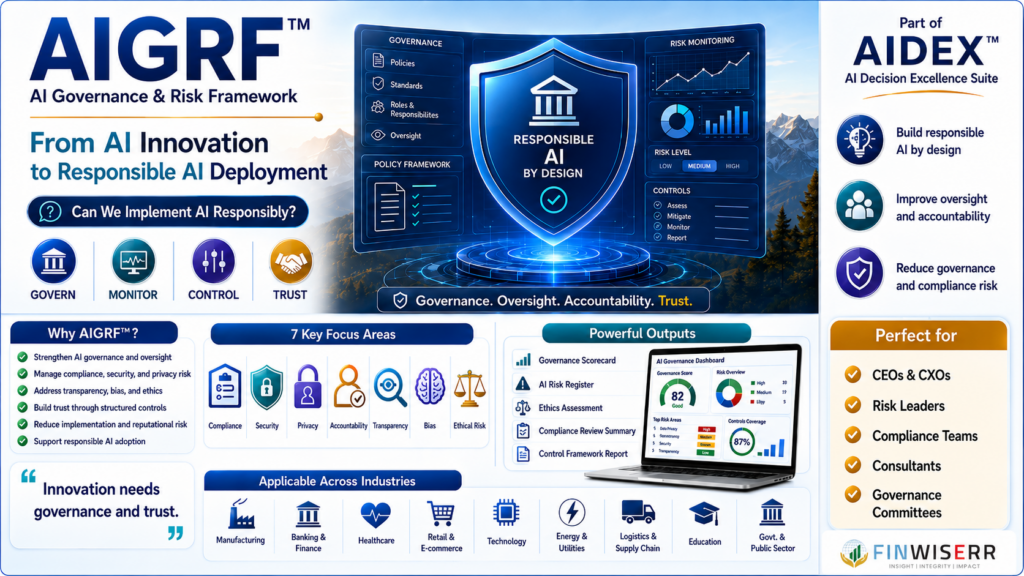
As AI systems become more influential, governance becomes increasingly important.
AIGRF™ helps organizations evaluate and manage areas such as:
- Regulatory compliance
- Data privacy
- Cybersecurity
- Ethical use
- Algorithmic bias
- Model transparency
- Accountability
- Human oversight
- Third-party risks
- Regulatory readiness
Responsible AI governance is essential for protecting the organization, its customers, and other stakeholders.
Stage 5: AIAF™ — AI Agent Assessment Framework
Executive question: Can AI operate autonomously?
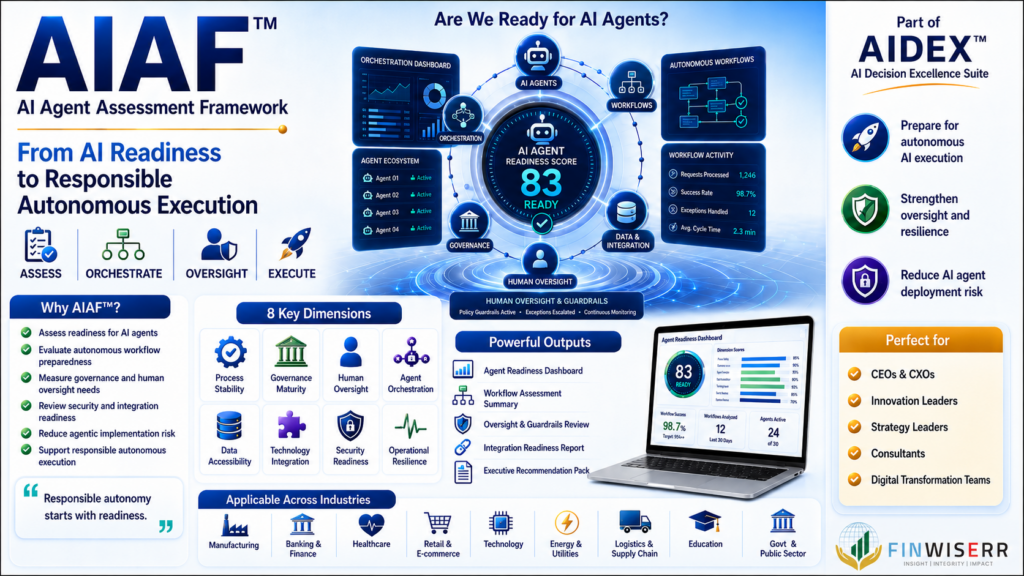
AI is evolving from tools that assist employees toward agents that may perform tasks, make recommendations, and execute decisions with varying levels of autonomy.
Before delegating activities to AI agents, organizations must evaluate:
- The importance of the decision
- The consequences of an error
- The level of human oversight required
- System security and access rights
- Escalation procedures
- Accountability
- Auditability
- Alignment with business objectives
Autonomous execution should only be introduced when the organization has the necessary controls, governance, and operational maturity.
Five Questions Every AI Investment Should Answer
Every proposed AI initiative should answer five fundamental questions:
- Are we ready for AI?
- Where should we invest first?
- Can the investment be financially justified?
- Can the solution be governed responsibly?
- Can AI operate with an appropriate level of autonomy?
When any of these questions remains unanswered, the organization may be accepting unnecessary financial, operational, or governance risk.
Why Better AI Decision-Making Matters
The AI market is full of impressive demonstrations, ambitious promises, and rapidly evolving technologies.
Yet organizations continue to experience:
- Failed AI pilots
- Low employee adoption
- Budget overruns
- Poor returns on investment
- Data and integration challenges
- Governance concerns
- Executive uncertainty
- Projects that never move beyond experimentation
The problem is not always the capability of the technology.
In many cases, the problem is that the investment was not supported by a clear business objective, adequate readiness, robust financial analysis, or appropriate governance.
At FINWISERR, we believe AI success begins long before implementation.
It begins with better decisions.
From “Where Can We Use AI?” to “What Is the Next Right AI Decision?”
Most organizations begin by asking:
Where can we use AI?
FINWISERR encourages leaders to ask a more strategic question:
What is the next right AI decision for our organization?
That shift changes AI from a technology-led initiative into a strategic business capability.
It encourages organizations to evaluate AI through the combined lenses of:
- Strategy
- Business value
- Financial viability
- Operational readiness
- Governance
- Risk
- Long-term organizational capability
Final Thoughts
Artificial intelligence will continue to reshape industries, redefine operating models, and create new opportunities.
However, the organizations that succeed will not necessarily be those that adopt AI first. They will be the organizations that make disciplined decisions before, during, and after implementation.
The FINWISERR AI Decision Matrix™ is designed to help leaders navigate this journey with greater clarity, structure, and confidence.
Because AI transformation should not begin with technology.
It should begin with better decisions.
About FINWISERR
FINWISERR is a strategic consulting and decision intelligence firm that helps organizations make informed, financially sound, and governance-driven AI decisions.
Through the AIDEX™ ecosystem—AIRDIF™, AIPIF™, AIBCF™, AIGRF™, and AIAF™—FINWISERR provides a structured methodology for evaluating:
- AI readiness
- AI investment priorities
- Financial business cases
- AI governance and risk
- Autonomous AI adoption
Take the Next Step
Is your organization ready to invest in AI, or should it strengthen its foundations first?
FINWISERR can help assess your current position, evaluate AI opportunities, and develop a structured roadmap for responsible and value-driven AI adoption.