Starting a business in the UAE is exciting, but it is also expensive. Setup costs, licensing fees, office leases, and operational expenses add up fast. Many entrepreneurs pour money into ideas without testing whether the numbers actually work. The result is often a business that struggles to break even or shuts down within the first three years.
The UAE economy expanded by 5.1% during the first nine months of 2025, with GDP reaching about AED 1.4 trillion. Foreign direct investment inflows hit a record USD 45.6 billion in 2024, a 48.7% jump from 2023, as reported by the UAE Ministry of Investment. The Central Bank of the UAE forecasts real GDP growth of 5.3 percent in 2026, supported by strong non-hydrocarbon activity. With this much capital flowing in and competition rising sharply, every new business needs proof that the opportunity is real.
This guide explains what a feasibility study UAE involves, what it should include, how much it costs, and how it protects your investment. You will also learn the difference between a feasibility study and a financial feasibility study, the step-by-step process to conduct one, and what investors and banks look for in a bankable report.
What is a Feasibility Study in the UAE?
A feasibility study is a structured analysis that tests whether a proposed business idea can succeed in a specific market.
In the UAE, this means evaluating local demand, regulatory rules, sector competition, capital requirements, and projected returns before you commit funds.
A good feasibility study answers a few critical questions. Is there real demand for the product or service? Can the business meet UAE licensing and compliance rules? Will the financial returns justify the investment? What risks could derail the project, and how can they be managed?
Why a Feasibility Study Matters in the UAE Market
The UAE attracted record FDI in 2024 because investors trust the regulatory framework and the diversification story. According to the UAE Ministry of Economy and Tourism, non-oil GDP grew 6.1% in the first nine months of 2025, with financial services up 9%, construction up 8.%, and real estate up 7.9%. These numbers create opportunity, but they also attract heavy competition.
A feasibility study reduces risk in three concrete ways. First, it forces you to validate demand with real data instead of assumptions. Second, it identifies regulatory and licensing requirements that vary across mainland and free zones. Third, it produces the financial projections that banks and investors require before they release capital.
The We the UAE 2031 vision aims to double GDP to AED 3 trillion within the next decade. That growth will favor businesses that enter the market with clear, defensible plans.
Core Components of a Feasibility Study UAE
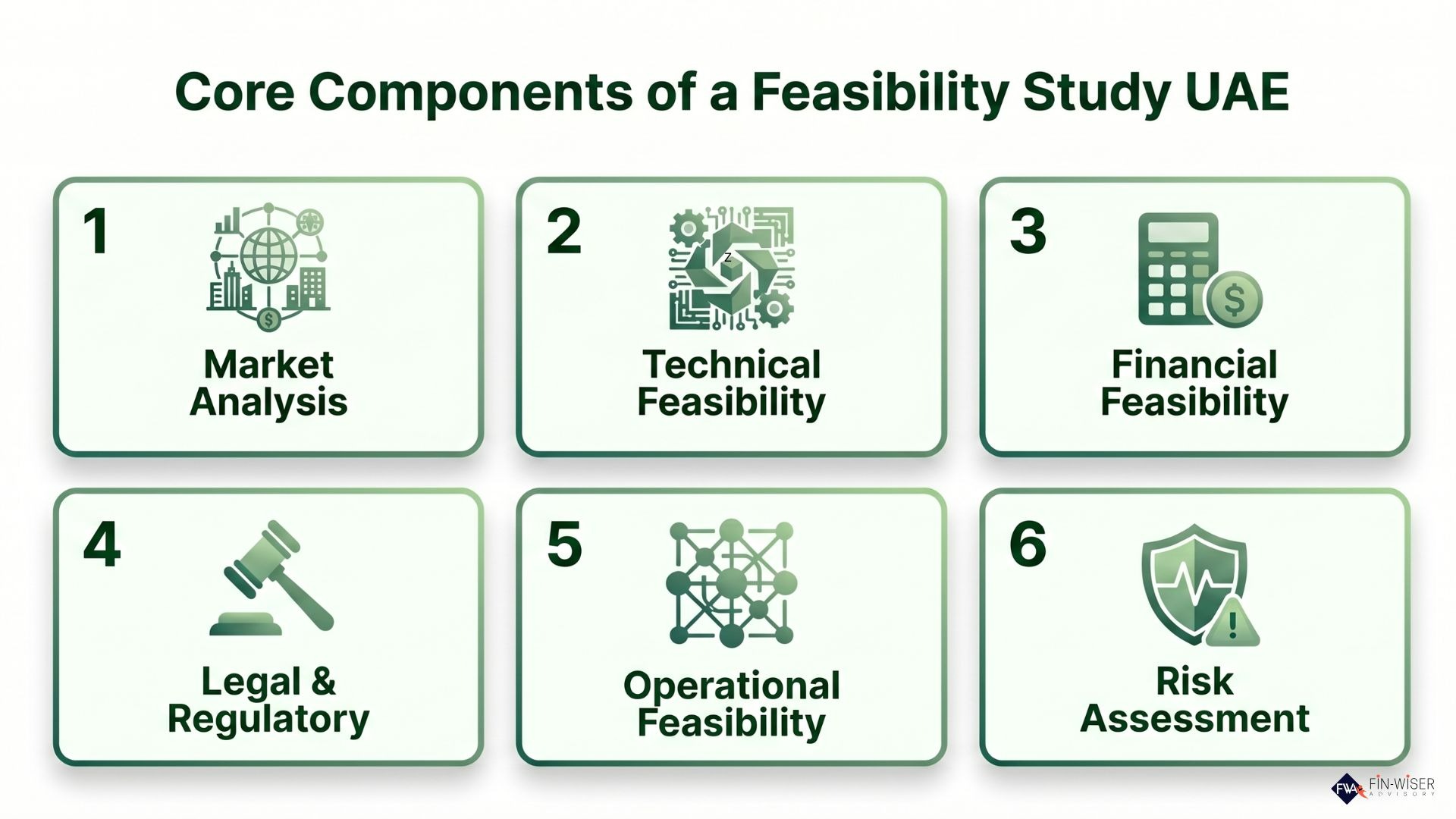
A comprehensive feasibility study evaluates six interconnected areas, each playing a critical role in assessing business viability. Overlooking any one of them can create significant blind spots in decision-making. Below are the six key components:
1. Market Analysis
This section measures demand, customer behavior, pricing benchmarks, and competitor positioning. It should use both secondary research and primary inputs such as interviews with industry contacts.
2. Technical Feasibility
This evaluates whether the project can be built and operated. It covers location, infrastructure, technology, equipment, supply chain, and staffing requirements.
3. Financial Feasibility
This is the heart of the study. It includes startup costs, working capital needs, revenue forecasts, operating expenses, profit margins, and key return metrics. A strong NPV and IRR analysis tells you whether the project creates value.
4. Legal and Regulatory Feasibility
The UAE has different rules for mainland companies, free zone entities, and offshore structures. This section reviews licensing, ownership, VAT, corporate tax, and sector-specific approvals.
5. Operational Feasibility
This examines day-to-day execution. Can you hire the right talent? Are suppliers reliable? Are logistics workable at the chosen location?
6. Risk Assessment and Sensitivity Analysis
Every project has risks. A serious study lists them, scores them, and stress-tests the financial model against changes in price, volume, and cost.
Step-by-Step Process to Conduct a Feasibility Study in the Dubai
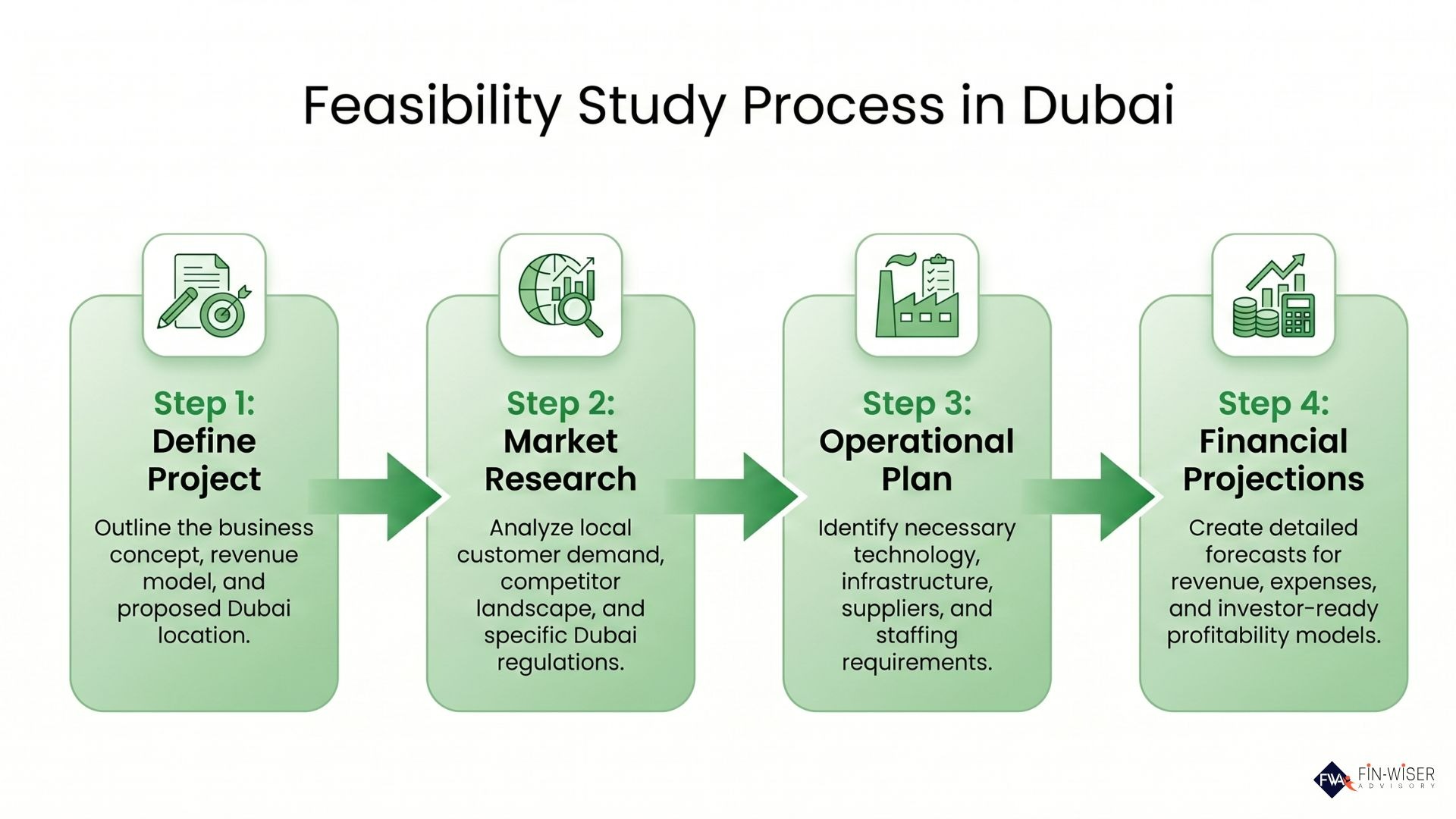
A feasibility study follows a structured process to evaluate whether a business idea is practical, profitable, and scalable in the UAE market.
Step 1: Define the Project
Clearly outline the business concept, target market, revenue model, objectives, and proposed location.
Step 2: Conduct Market Research
Analyze customer demand, competitor landscape, pricing trends, and relevant Dubai regulations.
Step 3: Prepare the Operational Plan
Identify operational requirements, technology, infrastructure, suppliers, and staffing needs.
Step 4: Develop Financial Projections
Create detailed financial forecasts covering revenue, expenses, cash flow, and profitability. Solid investor ready financial models link operational drivers directly to outputs.
Step 5: Assess Risks and Scenarios
Evaluate potential risks and test best-case, base-case, and worst-case business scenarios.
Step 6: Prepare the Feasibility Report
Summarize findings and provide a recommendation to proceed, revise, or halt the project.
How Much Does a Feasibility Study Cost in the Dubai?
Costs depend on project complexity, sector, and the depth of primary research. Most providers charge based on scope rather than a fixed rate.
| Project Type | Typical Cost Range (AED) | Typical Timeline |
|---|---|---|
| Simple single-product, single-market | 15,000 to 35,000 | 3 to 4 weeks |
| Mid-complexity, multi-product or multi-location | 35,000 to 80,000 | 5 to 8 weeks |
| Large infrastructure, energy, or PPP project | 80,000 and above | 8 to 12 weeks or longer |
Bankable feasibility studies for project finance, including renewable energy and infrastructure, usually fall at the higher end because lenders require deeper modeling and independent technical input.
Benefits of Conducting a Feasibility Study in the Dubai
A well-prepared feasibility study helps businesses reduce uncertainty, improve planning, and make informed investment decisions. Here are some key benefits:
- Reduced investment risk through early identification of weak assumptions and market gaps
- Stronger credibility with banks, investors, and regulatory authorities
- Clear data-driven go or no-go decision making
- Better understanding of UAE licensing, compliance, and tax requirements
- More realistic financial expectations, including costs and break-even timelines
- Improved operational planning for staffing, suppliers, and business setup requirements
Feasibility Study vs Financial Feasibility Study
These terms sound similar, but they cover different ground. A feasibility study is broader. A financial feasibility study sits inside it and zooms into the numbers.
| Aspect | Feasibility Study | Financial Feasibility Study |
|---|---|---|
| Scope | Market, technical, legal, operational, financial | Costs, revenues, profitability, returns |
| Output | Go or no-go decision on the project | Detailed financial model and projections |
| Used by | Promoters, regulators, partners | Banks, investors, CFOs |
| Key metrics | Demand, competition, compliance | NPV, IRR, payback, break-even |
For most UAE projects, you need both. The market study confirms the opportunity. The financial model proves the returns.
Industries Where Feasibility Studies Add the Most Value
Some sectors carry higher capital intensity and longer payback periods, which makes upfront analysis essential.
Real estate development needs feasibility work because rental yields and absorption rates change quickly. Renewable energy projects rely on tariff modeling and long-term offtake assumptions. Manufacturing depends on raw material pricing and export logistics. Hospitality and food and beverage businesses need careful demand and footfall studies. Healthcare and education require regulatory clearance and long lease commitments. Each of these benefits from rigorous project finance advisory before financing is locked in.
What Investors and Banks Look for in a Dubai Feasibility Report
Banks and equity investors do not just read the conclusion. They scrutinize the assumptions, the model structure, and the sensitivity tables. A bankable report shows realistic revenue ramp-up, defensible cost assumptions, clear sources and uses of funds, debt service coverage above lender thresholds, and a transparent risk register.
At Finwiserr, we help promoters build feasibility studies and financial models that meet these standards across renewable energy, real estate, manufacturing, and infrastructure projects in the UAE and the wider region.
Common Mistakes to Avoid in a Feasibility Study
Even a well-structured feasibility study can fail if key assumptions and risks are overlooked. Avoiding the following mistakes helps ensure the analysis remains realistic, reliable, and actionable.
- Overestimating revenue without accounting for market entry and growth timelines
- Ignoring hidden costs such as marketing, maintenance, licensing, and replacement expenses
- Skipping sensitivity analysis for pricing, demand, and operating costs
- Using outdated market or competitor data
- Making assumptions that conflict with UAE regulations and licensing requirements
Final Words
A feasibility study is not paperwork. It is the difference between investing into a clear opportunity and burning capital on assumptions. The UAE market rewards businesses that enter prepared, with validated demand, defensible numbers, and a financial model that holds up under scrutiny.
At Finwiserr, we help promoters, founders, and investors build feasibility studies and financial models that are genuinely bankable. Our team has worked across renewable energy, real estate, manufacturing, hospitality, and infrastructure projects in the UAE and the wider region. We focus on the details that lenders and equity investors actually check, including realistic revenue assumptions, clear sources and uses of funds, sensitivity analysis on the variables that matter, and debt service coverage that meets bank thresholds.
If you are planning an investment in the UAE and want a feasibility study that holds up to real scrutiny, get in touch with the Finwiserr team. A short conversation can save you months of effort and significant capital.
Talk to Our Feasibility Experts
Planning a business investment in the UAE? Connect with Finwiserr experts for reliable feasibility studies, financial modeling, and investor-ready insights that help you make confident decisions.
Talk to Our ExpertsFAQs About Feasibility Study UAE
How much does a feasibility study cost in UAE?
Costs typically range from AED 15,000 for simple single-product studies to AED 80,000 or more for complex infrastructure projects. The price depends on scope, the level of primary research, and whether financial modeling is included.
What is the difference between a feasibility study and a business plan?
A feasibility study tests whether a business idea is viable before you commit. A business plan describes how you will run and grow the business once you have decided to proceed. Feasibility comes first, the business plan follows.
How long does a feasibility study take in the UAE?
A simple study takes three to four weeks. A multi-product or multi-location study can take five to eight weeks. Large project finance studies often need eight to twelve weeks or more, depending on data availability and primary research scope.
Who prepares feasibility studies in UAE?
Independent advisory firms, audit and consulting firms, and specialized financial modeling consultancies prepare feasibility studies. Banks usually require the study to come from an independent third party rather than the promoter.
Is a feasibility study mandatory for business setup in UAE?
It is not legally mandatory for general business setup, but it is effectively required when raising bank debt, attracting equity investors, or applying for government tenders and PPP projects. Most serious investors and lenders will not engage without one.