

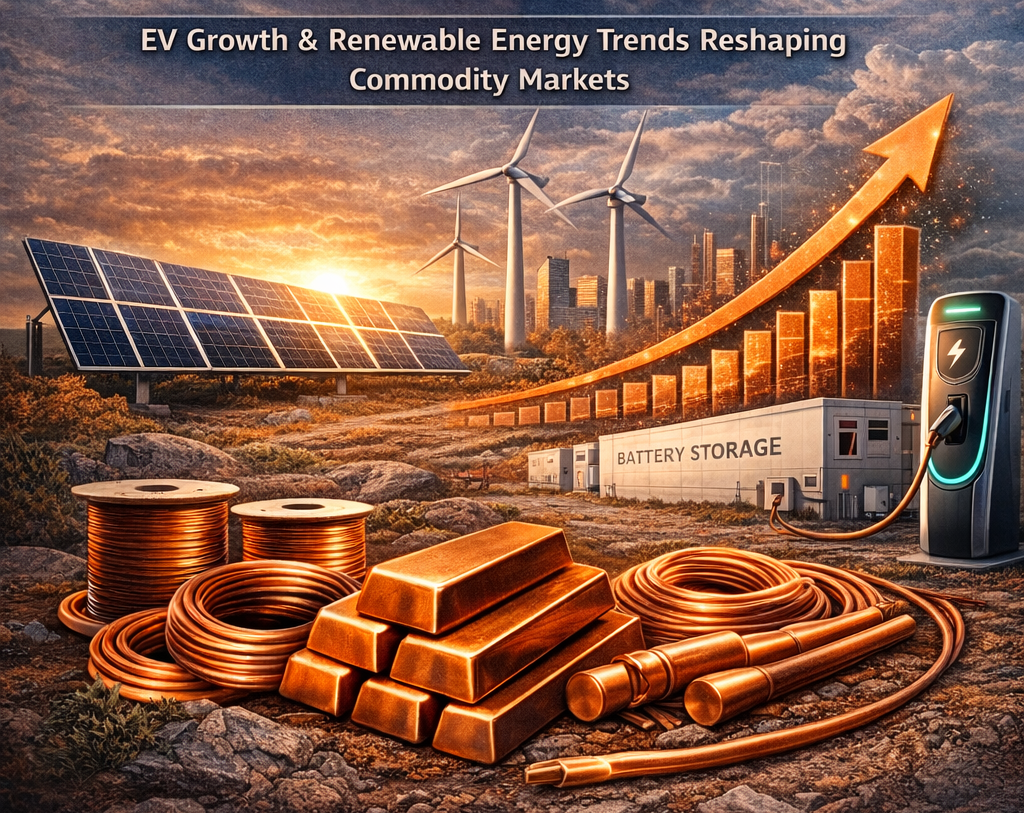
The trend towards clean energy and electrified transportation may be fundamentally environmental and evolutionary, but it also has implications for commodity markets. What lies at the very heart of all of this is the significance of copper as the material with the appropriate physical properties to facilitate the proliferation of the aforementioned technology and a clean future.
The surge of investments in clean technology, combined with the acceleration of government green initiatives, has further necessitated the importance of realizing the impact of EVs on the cost of copper, forecasted demand for copper, and the end-use consumption.
Why Copper Matters in the Energy Transition
Copper’s high electrical conductivity, corrosion resistance, and exceptional durability are some of the crucial aspects that make copper an essential metal in applications that require effective conductivity.
Unlike other metals, copper’s high performance is blended with applicability in:
- Electric motors
- Batteries and Charging Infrastructure
- Wind turbines and solar panels
- Grid modernization and energy storage solutions
This variety of applications guarantees that copper isn’t just part of the future, but drives it.
Copper Usage in EVs: A Major Component
One of the most significant factors that determines the demand forecast for copper is the “Rapid Growth in EV Adoption.”
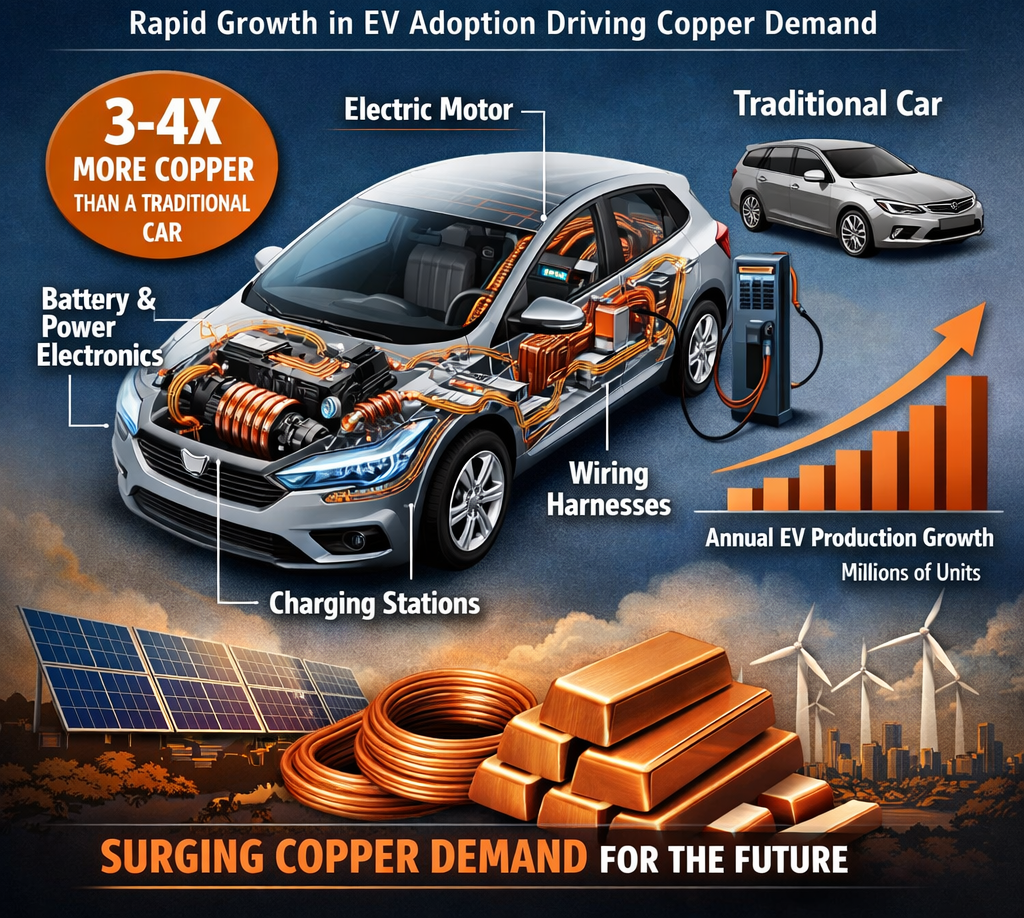
Compared to traditional combustion engine vehicles, EVs require substantially higher amounts of copper, “typically:
- Battery and power electronics
- Electric motors
- Wiring Harnesses
- Charging Stations
On average, an EV may have three to four times more copper than a traditional car. As the production goes into tens of millions, the rising trend continues to define new rules.
This increasing trend of copper in EVs is a major cause of optimistic predictions regarding the consumption of metals in the future.
EV Impact on Copper Prices
Those investors interested in investing according to commodity trends over the long term have already focused their attention on copper, and for good reason. The impact of EVs on copper prices can be seen in the data as expectations around tighter demand compared to supply.
Several factors are responsible for upward pricing pressures:
- Surging EV Production Targets
- Expansion of charging network deployments
- Government incentives for electrification
- Supply chain bottlenecks or resource constraints
Markets usually account for expectations of growth well before the actual supply/demand balance sheets start to tighten, thus indicating that trends in the Copper Price may indeed be precognitive economic indicators.
Beyond Vehicles: Renewable Energy Drives Demand Too
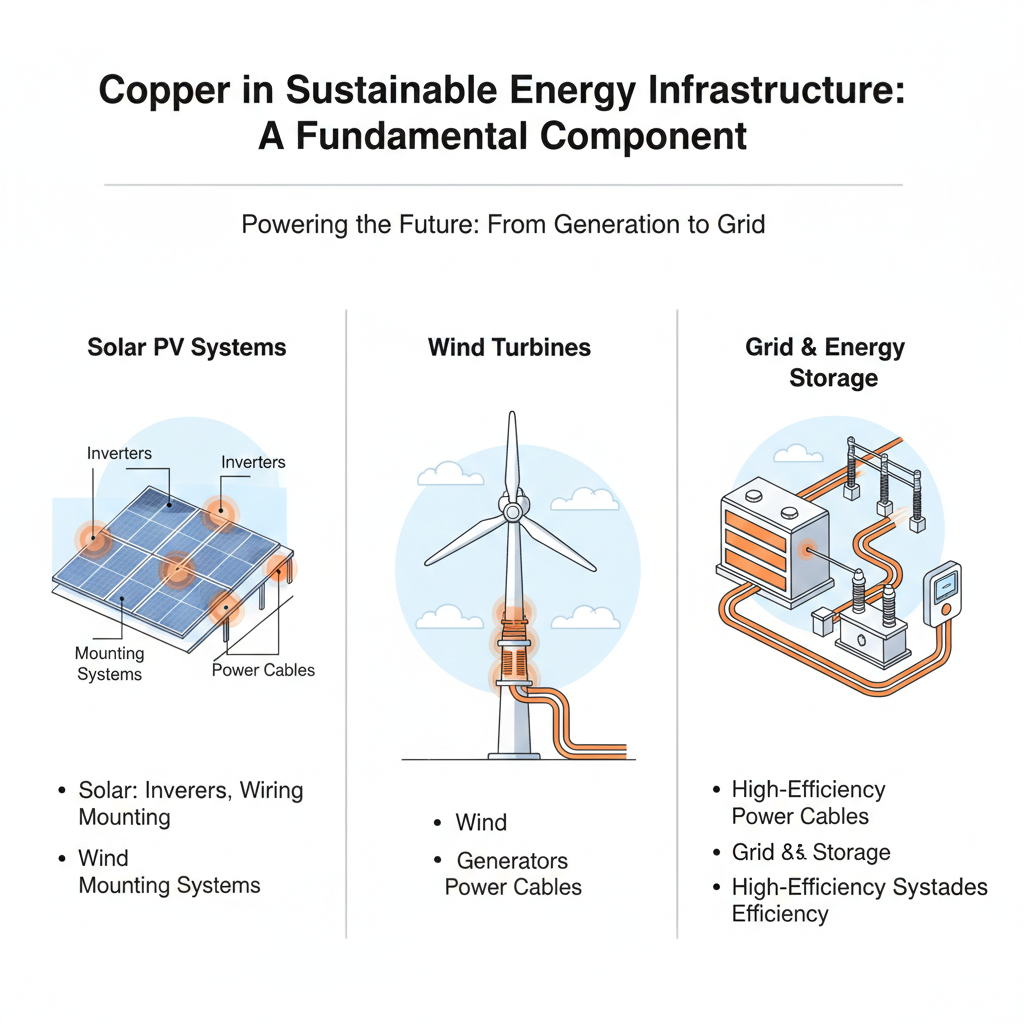
Even though electric vehicles feature significantly, the role of renewable energy infrastructure must be recognized as a substantial contributor to copper consumption.
–The solar PV systems contain copper in the inverters, wiring systems, and the mounting systems.
– Wind turbines require large quantities of copper for the generators and power cables.
– Upgrades to grid systems and energy storage systems increase their efficiency.
As nations are focused on the climate goals and rising capacities of clean power generation, copper is a fundamental component of the transport sector and the entirety of the sustainable energy landscape.
Copper Demand from Electric Vehicles
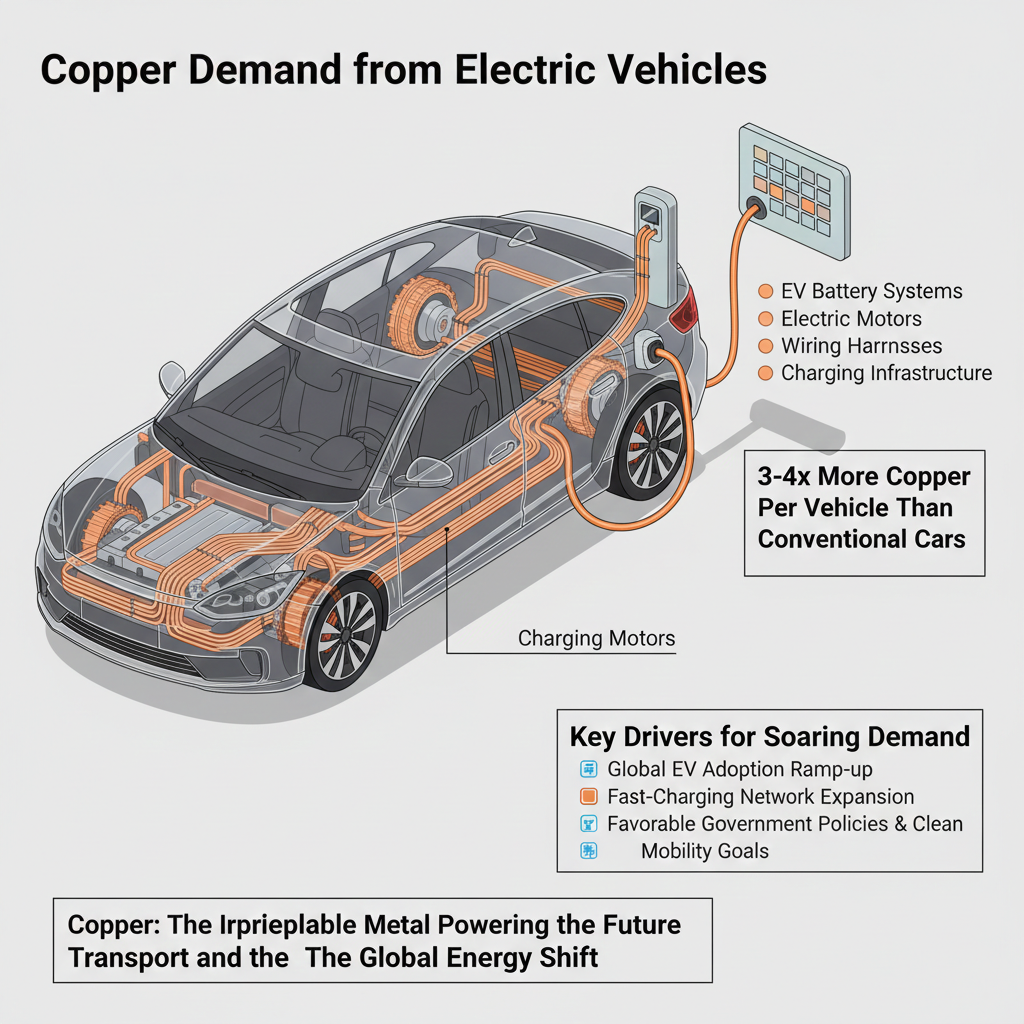
The rapidly growing demand for electric vehicles seems to highlight one of the strongest market opportunities for the demand for copper. Unlike conventional vehicles, electric vehicles heavily rely on electrical components.
For example, an electric vehicle will use three to four times more copper when compared to other vehicles running on petrol or diesel. The reason is quite simple, as copper finds extensive applications in the EV battery systems and electrical motors. The properties of copper make it irreplaceable for these applications, and other materials cannot substitute it.
With the scale-up of global EVs to tens of millions of units per year, there will be a sharp increase in automotive copper usage, especially as fast-charging infrastructure installations are expanded, thereby increasing demand as it requires a large amount of copper for cables, transformers, and grid connections.
These government policies regarding clean mobility, tougher emission regulations, and lowering battery costs further provide momentum to the adoption of EVs on a worldwide scale. The growing need to use copper makes the position of EVs vital in the prediction of copper prices in the future. The above statement again highlights the significance of copper in the energy shift process occurring globally.
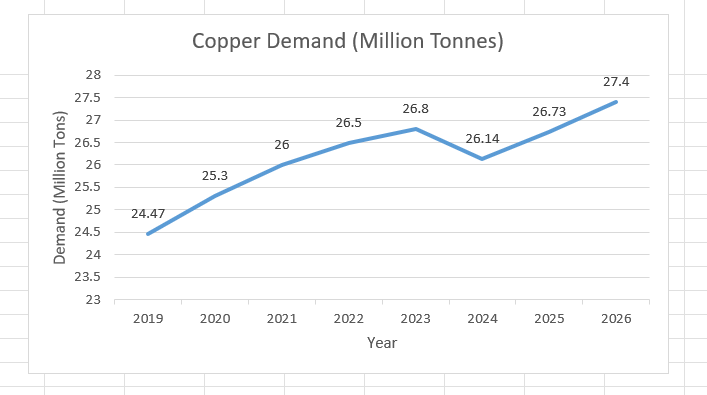
What the Copper Demand Forecast Tells Us
Analysts monitoring various commodities use trends observe the increasing demand for copper commodities over the last few years, fueled by:
1. EV production rampups
2. Renewable Energy Installations
3. Electrification and Smart Grid Upgrades
4 . Urbanization and Infrastructure Expansion
Longer term, demand could outstrip developments in mining supply if investment in supply, recycling, and efficiency technologies does not keep pace. Such an approach understandably prompts questions that extend beyond price to supply security, geopolitics, and investment.
Investor Takeaways: Trends & Risks
But for the investor, the story of copper is not limited to the demand-supply curve, as he is concerned with allocating resources to where the energy revolution is most palpable.
Copper Price Trends: What Investors and Markets Are Watching
Copper price movements have always been of significant concern as the market continually tries to adapt to the changing global demand rates, with a significant focus being placed on electric vehicles and other associated infrastructure. Copper is a significant factor in the electrification and decarbonization of infrastructure around the globe; therefore, the price movement of Copper is of huge significance to everybody.
Historical Context: Long-Term Cycles
Overall, the copper prices have been subject to a cyclical pattern, which is largely related to the economic growth rate prevailing across the world, including the industrial growth rate and supply input. Thus, in the context of sound economic performance, it is expected that the overall demand for copper as a base metal would increase, which would naturally lead to increasing copper prices.
Recent Drivers of Price Momentum
In the last few years, the following factors have mainly affected the volatility and rise of copper price trends:
Accelerated EV Adoption: As electric vehicles have a consumption that is three to four times that of internal combustion vehicles, the accelerated production of electric vehicles is enhancing the expectations for the consumption of copper and, hence, the prices.
Supply Constraints: Bottlenecks in production, mining, and geopolitical tensions affecting major mining regions exert upward pressure on the price of the metal.
Inflationary Pressures & Commodity Markets: Inflation and general monetary market trends may affect commodity prices as investors react to overall macroeconomic indicators.
Short-Term vs. Long-Term
While the short-term trend of copper price movement is known to change depending on the effects of economic data releases, interest rate changes, or currency fluctuations, the long-term trend of copper price movement is known to depend on the copper demand. Analysts who base their forecast on the demand indicators of the copper market report:
- The electric vehicle adoption rate and the charging stations installed
- Renewable energy capacity additions
- Mining Investment Cycles and Project Timeframes, Recycling and Material Efficiency, Technology Trends
Price Signals and Market Expectations
As copper plays an essential role in electrification technology, these movements are considered an early sign of broader trends.
For instance:
- The rising price of copper could be an indication of a tightening supply vs. demand scenario.
- Flat or falling prices may be symptomatic of an underdeveloped supply or an undersubscribed take-up for some critical technology.
For an investor, being sensitive to trends in prices is not only an issue of awareness towards figures, but also being aware of the way technology, political, and economic issues combine.
Key considerations include:
Copper Price Monitoring for the Growth of Electric Vehicles and Alternative Energy
Evaluating the exposure through equities, commodities, or ETFs linked with copper demand
Familiarity with the geopolitical environment of significant copper-producing countries. Green infrastructure policies: the substantial impacts of these policies on the market for raw materials
Conclusion: Copper at the Heart of a Greener World
The move toward electric cars and the development of renewable forms of energy go well beyond the realm of pure technology and represent an industrial revolution of considerable proportions for commodity markets worldwide. As the need for cleaner forms of energy continues to rise throughout the marketplace, the metal that continues to have the most associated story with the future relates to copper.
With copper demand now forecasted to increase and already seen to impact copper price significantly, copper is not just an essential commodity; it is strategically significant.
Knowing these trends can assist investors in making informed decisions, engineers in making sustainable infrastructure plans, etc.