
October 25, 2025

Market Hype vs Fundamentals: The True Test of Valuation

In today’s markets, prices often move faster than reason. The rise of market hype has blurred the line between storytelling and substance — where viral tweets, influencer commentary, and speculative euphoria can send a stock soaring overnight. Yet beneath that noise lies the one thing that never changes: fundamentals still decide the endgame.

The perfect illustration came in 2021, when GameStop — a struggling U.S. retailer — saw its share price skyrocket more than 1,700% in just two weeks, driven not by improving financial fundamentals, but by social media momentum. Millions of retail traders banded together on Reddit and TikTok, challenging Wall Street giants and creating a short-term phenomenon that broke every valuation analysis rule. But as the frenzy cooled, the price fell back toward its intrinsic value, proving that market hype can bend reality — never rewrite it.

This wasn’t an isolated case. From Tesla’s trillion-dollar run to cryptocurrency rallies, the last decade has shown that investor sentiment can overpower logic in the short term. But history keeps repeating one quiet truth — fundamental analysis always wins in the long term. A company’s true worth still depends on its cash flows, profitability, and growth sustainability, not on hashtags or headlines.

At Fin-Wiser, we believe understanding this tug-of-war between hype and fundamentals is essential to becoming a rational investor. Through our valuation and financial analysis services, we help investors look beyond crowd sentiment to uncover what a business is genuinely worth — its intrinsic value, grounded in data and discipline.

And for those who prefer to build their own insights, the Fin-Wiser Online Store offers professional valuation tools, DCF templates, and investment models that simplify complex analytics into actionable truth.

Because while market hype can make noise, fundamentals make history. The real test of valuation isn’t what investors believe today — it’s what the business delivers tomorrow.

Understanding Market Hype — The Power of Perception
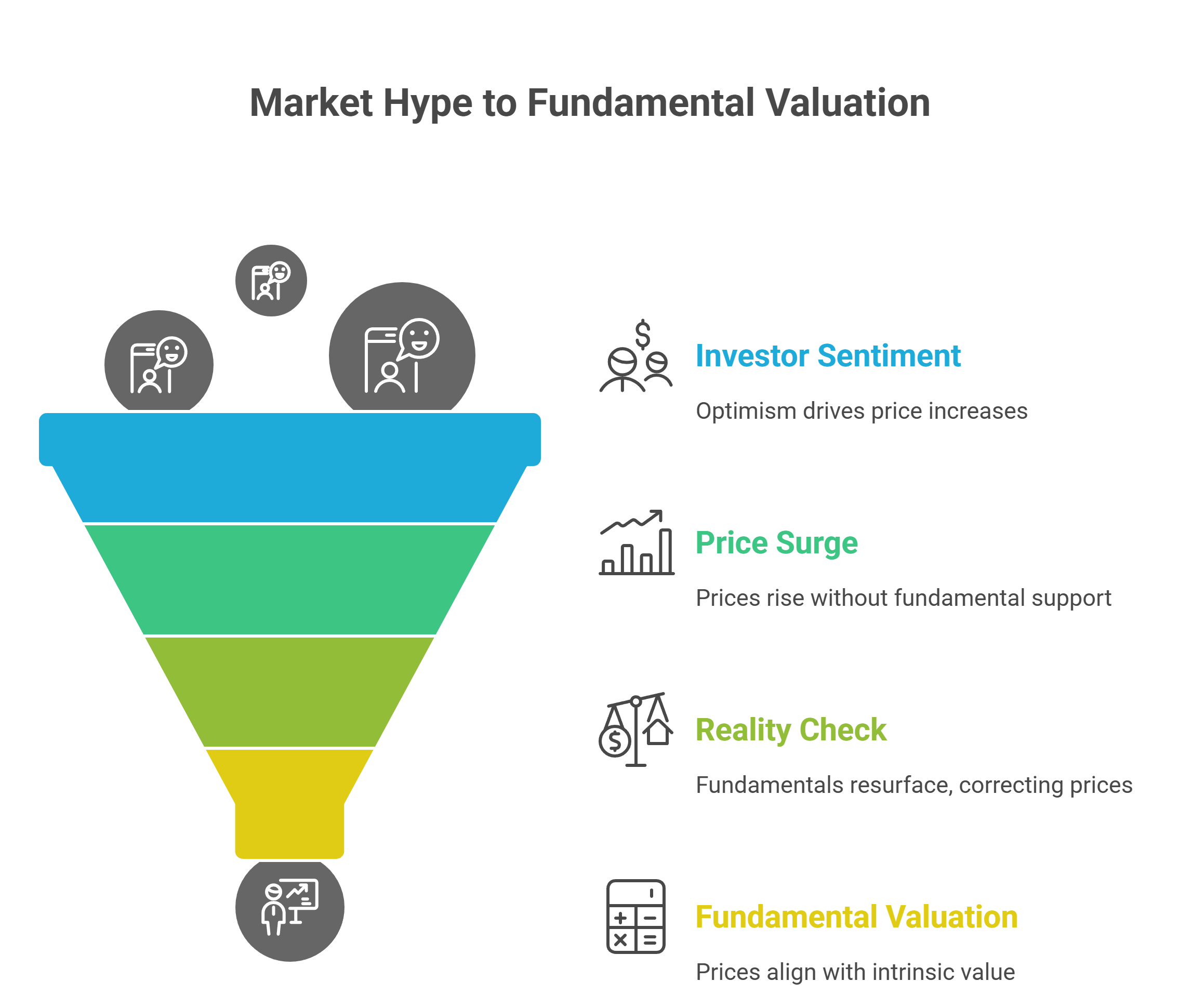
In the age of instant information, market hype spreads faster than earnings reports. A single tweet, trending video, or viral post can move billions in market value overnight. The result? Prices that reflect excitement, not economics.

Market hype thrives on investor sentiment — the emotional pulse of the market. When optimism turns into euphoria, prices rise not because fundamentals have improved, but because everyone believes they will. This herd behavior isn’t new; it’s the modern echo of centuries-old speculation. But today’s amplification through social media and real-time trading apps has made the swings far more dramatic.

Take the case of Dogecoin — a cryptocurrency born as a joke that hit a market capitalization of $85 billion in 2021, fueled almost entirely by memes and celebrity endorsements. Or AMC Entertainment, whose valuation jumped over 3,000% within months as retail investors coordinated online campaigns. None of these rallies were backed by cash flow growth, earnings performance, or intrinsic value — they were powered purely by perception.

This isn’t to say that market hype has no role in valuation. Momentum and narrative can serve as catalysts, especially for fast-growth companies. But hype without fundamentals eventually fades. As Benjamin Graham famously said, “In the short run, the market is a voting machine; in the long run, it is a weighing machine.”

At Fin-Wiser, we see this every day in our valuation and financial analysis services — stocks that look unstoppable during a hype cycle often regress to their true worth once financial fundamentals resurface. That’s why our approach blends behavioral finance insights with hard data — helping clients recognize when prices are driven by story, not structure.

For investors who want to analyze sentiment with logic, the Fin-Wiser Online Store features market analysis tools, DCF models, and valuation templates designed to separate excitement from evidence.

Because perception can move markets — but performance sustains them. The difference between a rally and a bubble lies in whether the story eventually meets the numbers.

Fundamentals Never Lie — The Foundation of True Value
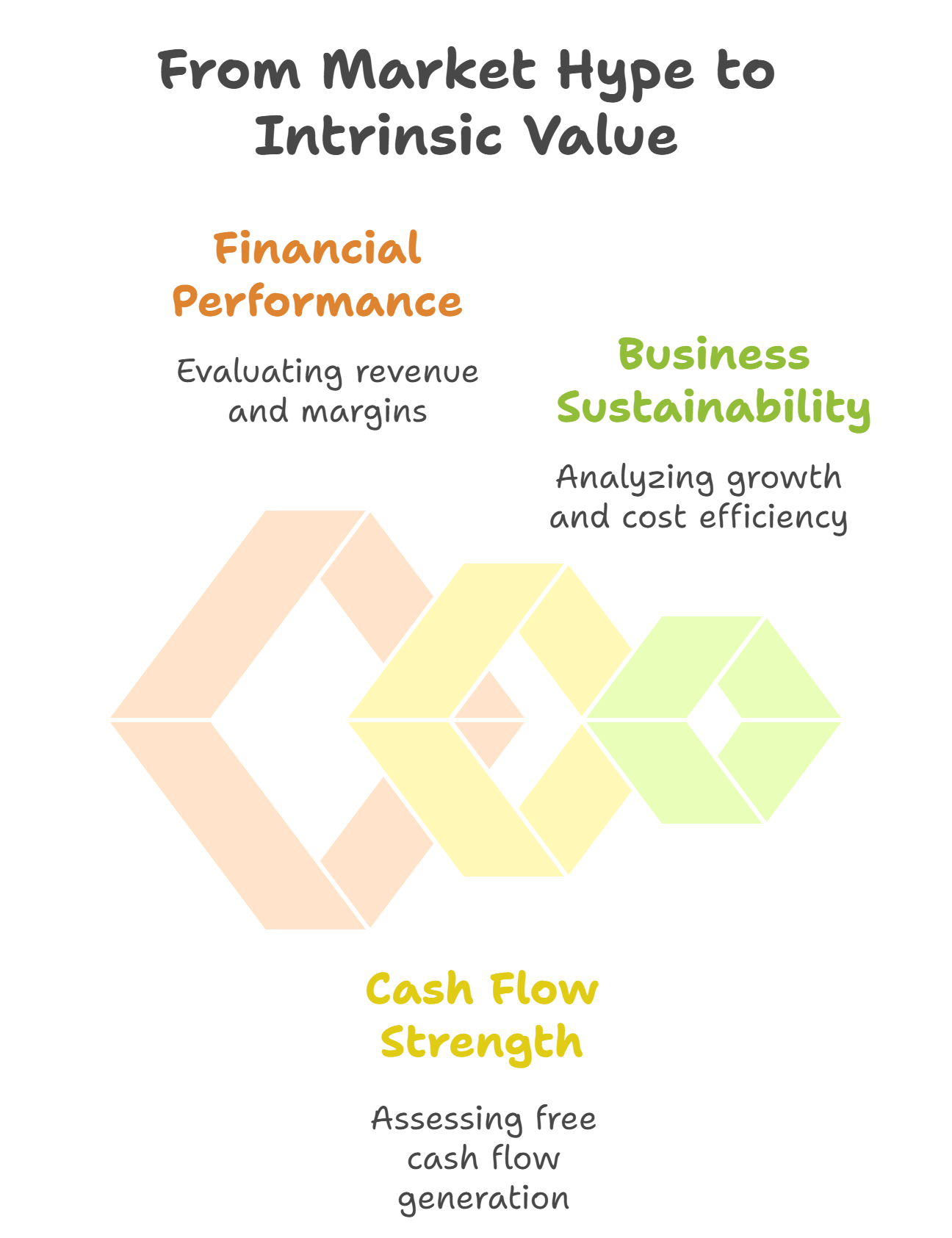
While market hype can move prices in the short term, fundamentals determine who wins in the long term. No matter how fast sentiment changes, the true anchor of company valuation remains financial performance, cash flow strength, and business sustainability.

Fundamental analysis isn’t glamorous, but it’s the most reliable truth detector in finance. It focuses on metrics that reveal a company’s real financial health — revenues, operating margins, free cash flow, return on equity, and earnings consistency. Together, these create a snapshot of intrinsic value — the worth of a business based on what it earns, not what investors hope it will earn.

Consider Apple and Microsoft — two of the world’s most valuable companies. Despite countless tech hype cycles, their dominance wasn’t built on speculation. In 2023, Apple generated over $100 billion in annual free cash flow, while Microsoft posted consistent double-digit growth across its cloud and software divisions. These numbers justify their valuation analysis, proving that strong fundamentals sustain value even when markets wobble.

Contrast that with companies like WeWork or Nikola, whose lofty market valuations once outpaced their business reality. When their financials failed to match their narratives, the market corrected — sometimes brutally. This is where fundamental analysis becomes the ultimate truth test, separating visionary businesses from overvalued illusions.

At Fin-Wiser, our approach to intrinsic value analysis is rooted in realism. Through our financial modeling and valuation services, we evaluate how a company’s cash flow generation, cost efficiency, and growth sustainability align with its current market valuation. Because no matter how persuasive the narrative, numbers must eventually justify the price.

For investors building their own assessments, the Fin-Wiser Online Store provides detailed DCF templates, financial ratio models, and valuation tools that make it easy to translate financial data into objective insights.

In the end, market hype may write headlines — but fundamentals write history. And while stories fade, strong balance sheets never go out of style.


 

Case Studies — When Hype Collapsed vs When Fundamentals Won

History has a simple lesson: market hype is temporary, but fundamentals endure. The world’s most famous market stories — from meme stocks to tech booms — all prove that valuation analysis eventually returns to one question: what is this business really worth?

When Hype Collapsed

The GameStop saga of 2021 remains a defining example of hype overshadowing logic. At its peak, the stock hit nearly $483 per share, driven purely by social media coordination and speculative excitement. But when the buying frenzy cooled, the stock lost over 80% of its value in months. The company’s financial fundamentals — declining revenue and shrinking margins — never justified the surge. It was a vote of emotion, not economics.

Similarly, WeWork’s 2019 IPO imploded spectacularly after analysts examined its numbers. The company’s valuation, once pegged at $47 billion, dropped to under $10 billion within weeks when investors realized that the hype around “tech disruption” didn’t align with its real estate-based business model. It was a sharp reminder that market hype can inflate perception but not profits.

When Fundamentals Won

On the other side, companies like Apple, Microsoft, and Nvidia demonstrate how strong fundamentals can outlast volatility.

  • Apple’s long-term success stems from consistent free cash flow generation, a resilient supply chain, and a loyal ecosystem that drives sustainable growth.

  • Microsoft’s cloud transition proved that disciplined execution beats temporary excitement — its steady earnings performance and predictable cash flows have supported one of the most reliable intrinsic value growth stories in modern history.

  • Nvidia, initially dismissed as “just a graphics card company,” turned into a trillion-dollar giant through innovation and real profitability, not speculative noise.

Each of these companies faced hype cycles but ultimately justified their valuations through fundamental strength — a principle we champion at Fin-Wiser.

At Fin-Wiser, we teach investors to look beyond momentum and measure the why behind every price. Through our valuation and financial analysis services, we help decode which rallies are built on lasting value and which are driven by fleeting emotion.

For analysts and investors who want to practice this discipline, the Fin-Wiser Online Store features case-based valuation models and scenario-testing DCF templates, helping you replicate real-world insights into data-backed conclusions.

Because while hype burns bright, it burns fast. Fundamentals, however, compound quietly — and always reclaim the spotlight in the end.


The Analyst’s Dilemma — Balancing Narrative and Numbers

Every great valuation story sits at the crossroads of market hype and fundamental analysis. The challenge for modern analysts isn’t choosing one side — it’s learning to interpret both. Ignoring investor sentiment risks missing market momentum; ignoring fundamentals risks losing touch with reality.

In today’s hyperconnected world, narrative-driven investing has become powerful. Analysts can’t afford to dismiss it entirely. A well-crafted story can drive a company’s valuation higher in the short term by attracting capital and confidence. For example, Tesla’s rise wasn’t only about cars — it was about a clean energy revolution. The story created a movement, and for years, its market valuation outpaced its earnings. But what ultimately sustained Tesla’s position wasn’t belief — it was delivery: record cash flow, strong margins, and growing global dominance.

This duality defines what we call the “Analyst’s Dilemma.” You must respect the narrative but measure it through numbers. Tools like Discounted Cash Flow (DCF) models, scenario analysis, and sensitivity testing help bring objectivity to emotional markets. They allow analysts to ask: If the story plays out, what is it truly worth?

At Fin-Wiser, we train our clients and partners to think this way — combining behavioral finance awareness with data-driven valuation. Our financial modeling and valuation services are designed to quantify vision without overvaluing it, bridging the gap between sentiment and substance.

For independent professionals, the Fin-Wiser Online Store includes DCF templates, narrative valuation frameworks, and risk calibration tools that help balance optimism with logic. Because true valuation mastery isn’t about rejecting the story — it’s about testing it against the spreadsheet.

In the end, great analysts don’t silence the noise; they interpret it. The real skill lies in understanding when market hype signals opportunity — and when it warns of danger.


Conclusion — Valuation’s Real Test Is Time

In the end, markets are full of noise, but time filters truth. Market hype can inflate prices for a season, yet fundamentals determine which companies endure beyond the cycle. Every investor, from retail traders to institutional analysts, eventually faces the same test — the reconciliation of perception with performance.

History proves it repeatedly. The dot-com boom of the early 2000s, the meme stock frenzy of 2021, and countless speculative surges in between all share the same pattern: excitement drives valuation, but intrinsic value decides survival. When the hype fades, only businesses with strong financial fundamentals, stable cash flows, and sustainable growth models remain standing.

That’s why at Fin-Wiser, we believe valuation is a marathon, not a moment. Our philosophy blends data discipline with market awareness, ensuring that analysis never loses sight of the long-term horizon. Through our valuation and financial analysis services, we help investors and analysts look beyond noise — to quantify potential, manage risk, and uncover value rooted in fact, not frenzy.

For those building their own models, the Fin-Wiser Online Store provides professional DCF templates, valuation tools, and fundamental analysis frameworks to test assumptions over time — because true investing is about endurance, not excitement.

Ultimately, the true test of valuation isn’t the market’s reaction today — it’s the business’s performance tomorrow. Market hype can create wealth, but fundamentals preserve it. And that, more than any chart or headline, is what defines real value.

In this article:
Share on social media:
Facebook
Twitter
LinkedIn
Telegram

Related articles