Every year, a fresh wave of IPO valuation hype floods the market — glossy prospectuses, overbooked issues, and social media filled with “next big thing” predictions. Retail investors queue up with excitement, hoping to ride the wave of early profits. But behind that glitter lies a quieter question that truly matters: What’s the company actually worth?
At its core, an Initial Public Offering (IPO) is a company’s debut performance on the stock market — the moment private ownership turns public. The IPO valuation is the price tag investment bankers and underwriters place on that debut. It reflects market sentiment, brand buzz, and future expectations — not always financial reality.
On the other hand, intrinsic value tells a deeper story. It’s the true worth of a business, grounded in numbers, not narratives — derived from fundamentals like cash flow projections, discounted cash flow (DCF) models, growth potential, and risk assessment. Unlike IPO pricing, which is often influenced by market demand, intrinsic value reflects the company’s actual ability to generate future returns.
This valuation gap between IPO price and intrinsic value is where many investors stumble. Companies like Paytm and Zomato entered the market with multi-billion-dollar IPO valuations, only to see their post-listing prices fall sharply when reality met expectations. The difference wasn’t just numbers — it was a clash between hype and fundamentals.
At Finwiserr, we help investors look beyond the headlines. Through our financial analysis services and in-depth valuation frameworks, we focus on what truly defines a company’s value — not just its market story. Whether you’re studying an IPO prospectus or building your own model, understanding this gap is key to smarter investing.
And if you’re ready to run your own valuation, the Finwiserr Online Store offers professional-grade DCF models, valuation templates, and investment tools designed to help you calculate intrinsic value with real-world precision.
Understanding IPO Valuation: Market Hype in Numbers

Every Initial Public Offering (IPO) begins with a story — one that promises growth, innovation, and market dominance. But behind that story sits the number everyone obsesses over: the IPO valuation. How that number is set reveals just how much market psychology shapes modern finance.
When a company goes public, its IPO valuation is typically determined by underwriters who weigh a mix of financial performance, industry comparables, future projections, and — perhaps most powerfully — investor demand. It’s an intricate dance between valuation science and marketing strategy.
During bull markets, valuation discipline often gives way to narrative momentum. Companies like Rivian, Airbnb, and DoorDash all entered the market with valuations that stretched far beyond traditional multiples. Rivian, for example, debuted in late 2021 with an $86 billion IPO valuation — higher than Ford — despite delivering fewer than 1,000 vehicles. Similarly, Airbnb’s $47 billion valuation reflected optimism about post-pandemic travel rather than actual earnings. These are textbook examples of how sentiment can outweigh fundamentals.
In such moments, the IPO price isn’t set by intrinsic performance — it’s driven by perception, scarcity, and FOMO (fear of missing out). When investors expect demand to soar, they’re often willing to pay any price today, assuming someone will pay more tomorrow. That’s what inflates market capitalization on day one — not necessarily what the company’s intrinsic value supports.
The process also includes comparative pricing — benchmarking against peers. If a listed competitor trades at 10x revenue, underwriters may justify 12x for a faster-growing IPO. But when optimism turns to caution, those inflated multiples quickly contract — leaving investors with an expensive lesson in market euphoria.
At Finwiserr, we analyze these dynamics beyond the headlines. Our valuation and financial modeling services focus on dissecting what drives true worth — earnings power, risk factors, and sustainable growth — rather than hype-driven assumptions. Because markets move fast, but fundamentals always catch up.
For those who prefer to do their own deep dive, the Finwiserr Online Store offers professional-grade DCF templates, IPO valuation models, and investment tools trusted by analysts worldwide to calculate intrinsic value with precision.
When market noise grows loud, understanding how IPO valuation is crafted — and where it diverges from intrinsic value — becomes your most powerful edge as an investor.
The True Meaning of Intrinsic Value
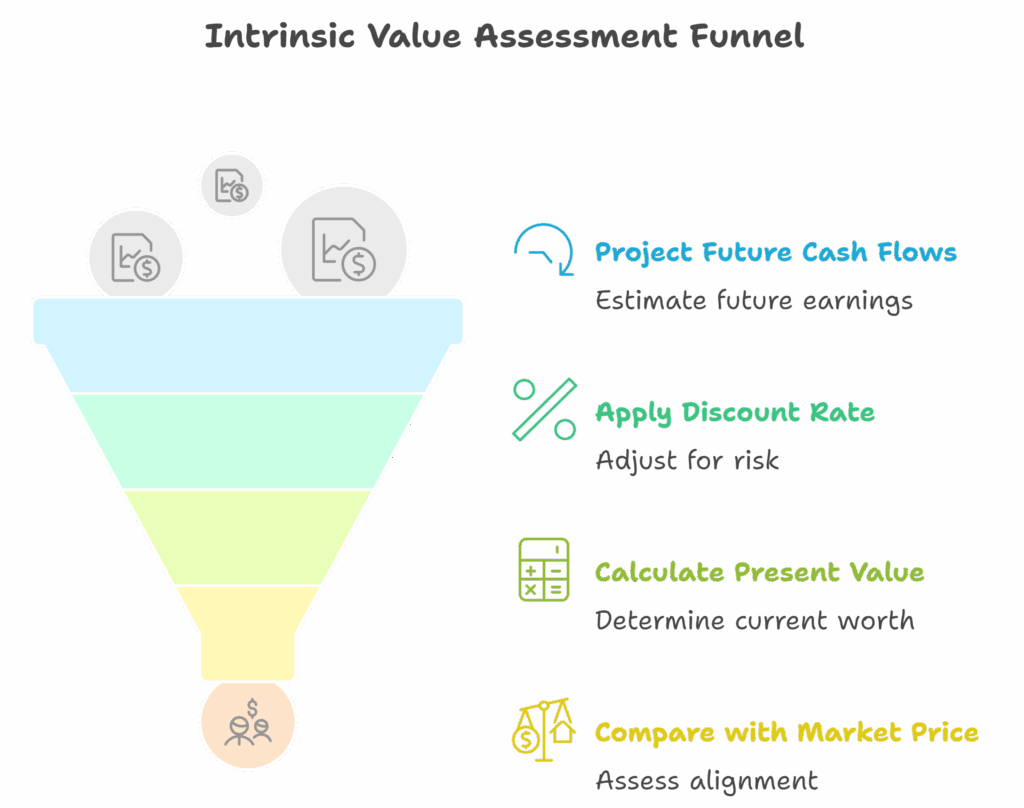
While IPO valuation reflects what the market is willing to pay today, intrinsic value represents what the business is truly worth over time. It’s the anchor that separates investment from speculation — and the foundation of long-term wealth creation.
Intrinsic value is rooted in one simple principle: a company is worth the present value of all the cash it will generate in the future. The most trusted way to estimate this is through the Discounted Cash Flow (DCF) model — a financial framework that projects future free cash flows, applies a discount rate based on risk, and brings those numbers back to today’s value.
This method may not sound flashy, but it cuts through noise. When Tesla, Amazon, or Netflix went public, their IPO valuations were driven by optimism. But what sustained them wasn’t hype — it was a growing stream of cash flow, consistent revenue expansion, and an eventual alignment between price and intrinsic value.
In contrast, companies that chase high valuations without sustainable cash flow — think WeWork or Robinhood — often face steep corrections once investor euphoria fades. The difference between price and value always narrows eventually; the question is whether investors wait patiently or panic prematurely.
At Finwiserr, we help decode these layers of intrinsic valuation through data-driven analysis. Our team dives into DCF models, revenue forecasts, and risk-weighted return assessments to help investors understand what the numbers actually imply — beyond the excitement of the market.
With the help of our valuation and investment services, investors learn to differentiate between value discovery and price setting — two concepts that sound similar but drive very different decisions. Value discovery is built on research, modeling, and discipline, while price setting is often dictated by emotion, timing, and demand.
And for those who prefer a hands-on approach, the Finwiserr Online Store offers powerful valuation models, DCF templates, and equity research tools that enable you to estimate intrinsic value with confidence and accuracy — the same way professional analysts do.
In a market where prices can swing wildly by the hour, intrinsic value remains the one element that doesn’t bend to sentiment. It’s the quiet truth behind every stock chart — and the ultimate measure of what makes an investment truly sound.
Why the Gap Exists: Psychology, Timing & Narrative
The difference between IPO valuation and intrinsic value rarely comes from spreadsheets alone — it’s born from human behavior. Markets aren’t perfectly rational systems; they’re reflections of emotion, timing, and storytelling. And together, these forces often widen the gap between what a company is worth and what investors believe it’s worth.
1. Investor Psychology and FOMO
When markets run hot, investor sentiment can overpower logic. The fear of missing out — or FOMO — becomes the invisible driver behind many IPO surges. Think back to Airbnb’s 2020 IPO: shares doubled on listing day, pushing its market cap above $100 billion, even though the company had reported significant losses during the pandemic. The excitement wasn’t about fundamentals — it was about being part of a global comeback story.
At Finwiserr, we often remind investors that momentum doesn’t equal value. Our valuation and research services are built around discipline — not hype — helping clients cut through short-term noise and identify sustainable worth based on data, not emotion.
2. Media Hype and Market Narratives
Media coverage plays an outsized role in shaping perception. When Robinhood went public in 2021, headlines framed it as the future of retail investing. Its IPO valuation soared to nearly $32 billion, only for the stock to lose more than 70% of its value within a year. Why? Because the narrative outpaced the numbers.
Stories sell — and IPOs are designed to tell them well. But while the press amplifies promise, intrinsic value is earned through consistent execution, not headlines.
3. Timing the Market
Another key factor is market timing. Companies often go public when market conditions are euphoric — not necessarily when their balance sheets are strongest. Rivian is a perfect example. In November 2021, the electric-vehicle startup went public amid global EV optimism, commanding an $86 billion valuation — higher than Ford — despite generating minimal revenue. Within months, as sentiment cooled, the stock halved.
This isn’t manipulation — it’s strategy. IPO timing is often engineered to capture peak investor enthusiasm. That’s why it’s crucial for investors to assess whether the valuation multiple reflects long-term performance or short-term opportunity.
4. The Power of Storytelling
Finally, no element widens the gap quite like corporate storytelling. Visionary founders can transform financial projections into dreams investors want to believe in. From WeWork’s “tech company” pitch to Uber’s global expansion narrative, stories build excitement — sometimes at the expense of valuation reality.
But storytelling isn’t inherently bad. It’s what inspires markets. The problem arises when valuation metrics bend to fit the narrative instead of the other way around.
That’s why the Finwiserr Online Store includes tools designed to bring investors back to fundamentals — from DCF calculators to valuation templates that strip away bias and reveal a company’s intrinsic worth in clear, measurable terms.
In truth, every bubble, correction, or rally begins not with numbers but with belief. Understanding those psychological levers is what separates emotional investing from value-driven decision-making — the Finwiserr way.
Lessons for Retail Investors: Avoiding the Trap

For most retail investors, IPO valuation can feel like chasing a moving train — fast, exciting, and risky if you don’t know where it’s headed. But understanding intrinsic value before you jump aboard can make all the difference between speculation and strategy.
1. Read Beyond the Prospectus
Every IPO comes with a prospectus, but very few investors actually dig into it. Instead of focusing on hype headlines, look at cash flow trends, operating margins, and debt ratios. If a company’s growth story isn’t backed by improving fundamentals, its IPO valuation is likely inflated.
For instance, during Uber’s IPO in 2019, despite massive revenue, losses exceeded $3 billion that year — signaling that intrinsic value would take years to catch up with the price tag.
At Finwiserr, we encourage investors to question every headline number. Our valuation and investment services help decode financial statements and identify the metrics that matter most before putting your money at risk.
2. Compare With Industry Benchmarks
One of the simplest ways to detect overvaluation is to compare valuation multiples — such as EV/EBITDA, Price-to-Sales, or P/E ratio — with established peers. If a company’s multiples are significantly higher than competitors with stronger cash flow, it’s a red flag.
The Rivian IPO again serves as a classic case: its valuation exceeded automakers like Ford and General Motors, despite negligible revenue. That disconnect shows why benchmarking is essential to assess intrinsic value objectively.
3. Use a DCF Model — Not Guesswork
The Discounted Cash Flow (DCF) model remains the gold standard for calculating intrinsic value. By forecasting future free cash flows, applying a suitable discount rate, and adjusting for risk, you can estimate a company’s fair value — not just what the market hopes it’s worth.
You don’t need to be a Wall Street analyst to do this. The Finwiserr Online Store provides intuitive DCF templates and valuation models that allow everyday investors to run these calculations with clarity and confidence.
4. Don’t Fall for Short-Term Gains
Many retail investors enter IPOs expecting quick flips. But markets have shown time and again — from Coinbase to Birkenstock — that post-listing volatility can erase those early paper profits within days. Investing in IPOs should always be a long-term conviction built on intrinsic strength, not listing-day hype.
5. Focus on Margin of Safety
Even the best analysis includes uncertainty. That’s why legendary investors like Warren Buffett emphasize a “margin of safety” — buying below intrinsic value to protect against market swings. When you understand how far IPO valuation exceeds intrinsic worth, you can decide whether the potential upside justifies the risk.
At Finwiserr, our mission is to make financial literacy and value-based investing accessible to everyone. Whether you’re analyzing a pre-IPO firm or refining your long-term strategy, we believe that knowledge — not noise — drives real returns.