
You’ve built the discounted cash flow model. Revenue projections are tied to business drivers. The valuation assumptions are backed by comps and benchmarks. The discount rate is stress-tested across multiple scenarios.
But when it comes time to present it, most people get it wrong.
The technical work is solid, but the valuation communication is unclear. The message gets lost in spreadsheets, jargon, or too much detail. And that’s where the value of the work starts to erode.
A well-structured DCF pitch isn’t about showcasing every formula. It’s about distilling the key drivers of value in a way that resonates with the audience—whether that’s a VC, private equity partner, CFO, or board member.
We’ve seen this firsthand at Fin-Wiser. A clean model is necessary. But a clear story behind that model is what actually gets decisions made. That’s why our financial advisory work always includes helping clients shape their message—not just their math.
The goal of this guide is to show how to present your financial model in a way that aligns with the expectations of investors and internal stakeholders alike. From simplifying your assumptions, to highlighting the metrics that matter, to answering the right questions before they’re asked.
If you’re building your model now or reworking your pitch materials, our DCF templates are structured for both calculation and presentation. They’re built to help you move from Excel to executive-level communication, fast.
Now let’s look at how your audience shapes the way you present your valuation.
Know Your Audience — Investors vs. Internal Stakeholders
Before you open your deck or walk through a single number in your discounted cash flow model, you need to ask one question: who are you presenting to?
This matters more than people realize. A solid DCF pitch can fall flat if it’s not tailored to the expectations of the people in the room.
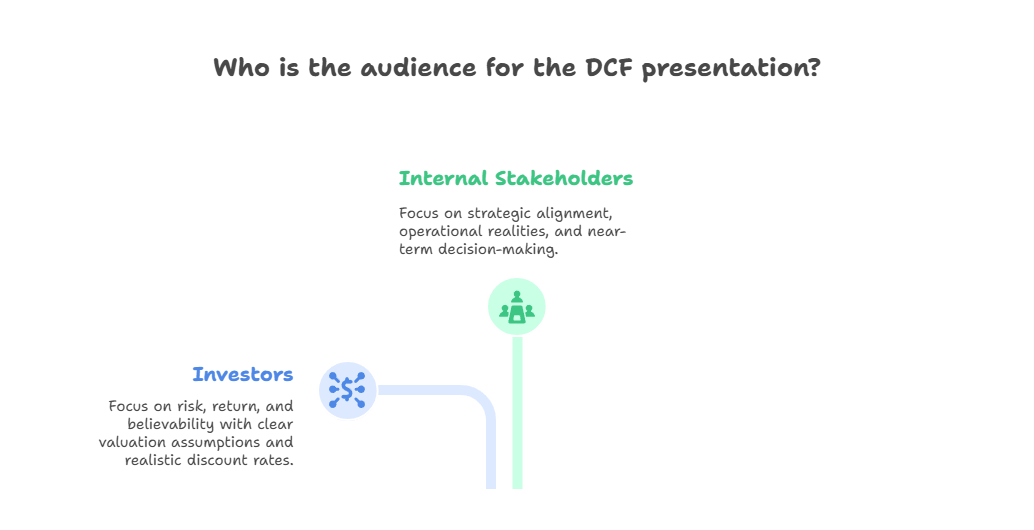
Investors Focus on Risk, Return, and Believability
When presenting to investors, you’re dealing with people who have seen hundreds of financial models. They’re not looking for the most complex spreadsheet—they’re looking for the cleanest story with the least room for doubt.
What they expect:
Clear, defensible valuation assumptions
A realistic discount rate, not just an industry average
Growth projections backed by market data, not just internal goals
Sensitivity or scenario analysis showing what happens if your base case doesn’t hold
Most importantly, investors want to know how your model connects to their return. Can they trust the inputs? Are you being aggressive or conservative? Where’s the downside?
At Fin-Wiser, we help clients prep for these conversations by identifying the parts of their DCF modeling investors are most likely to challenge. Through our financial advisory work, we’ve seen that even a great model will fall apart if you can’t answer follow-up questions clearly.
Internal Stakeholders Need Alignment and Execution Logic
Now shift to internal audiences: your board, CFO, or executive team. These stakeholders aren’t looking for investor returns. They’re trying to understand how the valuation reflects strategic priorities, business realities, and near-term decision-making.
Their focus is different:
Does this financial model reflect how we actually operate?
Are we projecting growth from pricing, expansion, or retention?
What assumptions are within our control, and which ones aren’t?
How does this valuation affect funding, hiring, or investment decisions?
In this setting, you need to connect the DCF valuation to real business levers. The conversation is less about IRR and more about how to hit your base case with the current resources.
This is where we see clients struggle most—trying to use investor-facing slides in internal discussions. If you need a more flexible setup, our DCF templates include versions tailored for internal strategy reviews as well as external investor pitches.
Understanding your audience isn’t just about tone. It changes what you show, what you explain, and how deep you go. A well-prepared DCF pitch doesn’t just answer questions—it avoids the wrong ones from being asked in the first place.
The DCF Pitch — What to Show, What to Skip
The biggest mistake in a DCF pitch is trying to walk through the entire financial model. You’re not there to teach valuation theory. You’re there to communicate your results—and give people confidence in your numbers.
Whether you’re talking to investors or internal stakeholders, the best presentations don’t overload. They focus on the few inputs that matter, the core assumptions that drive value, and the metrics that reflect how the business actually works.
Here’s what you need to show—and what’s better left out.
Show: Key Drivers and Assumptions
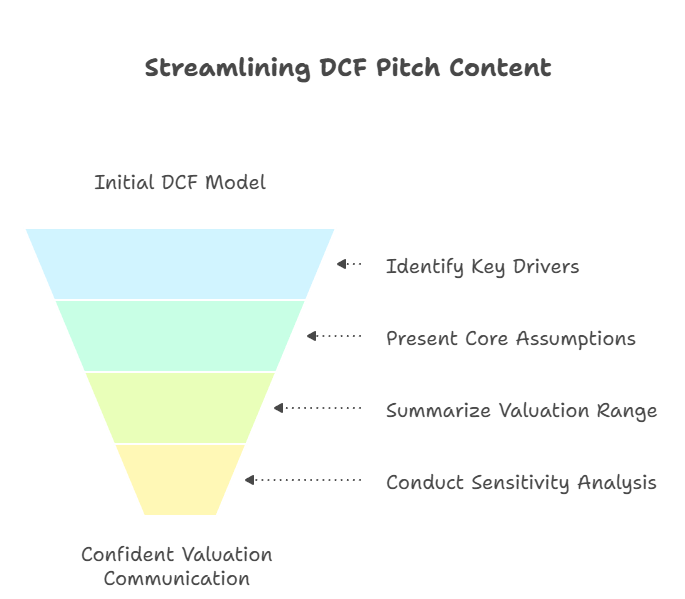
Start with the inputs that move the model the most—top-line revenue, margin expansion, customer retention, capital needs, and exit assumptions.
For example:
If 70% of your valuation is tied to revenue growth, show where that growth is coming from.
If your margin assumptions are critical, tie them to current cost structures or improvement initiatives.
If your discount rate is lower than average, explain why the business risk is lower than peers.
This is where defensibility matters. A 25% EBITDA margin projection will raise eyebrows unless you have industry comps or internal efficiency plans to support it.
Need help backing up these assumptions? Our financial advisory team helps clients anchor projections with third-party data, sector benchmarks, and operational rationale—so the model holds up under scrutiny.
Show: Output Summary and Sensitivity
Once the assumptions are clear, go straight to the output: the discounted cash flow valuation range. Keep it simple. Present a base case, maybe an upside/downside scenario, and summarize the implied enterprise value or equity value.
Then show how sensitive the outcome is. Change one or two key assumptions—like WACC or terminal growth—and show the impact on valuation.
This builds trust. It shows you understand the limits of your model and have tested it. All of this is built into Fin-Wiser’s DCF templates, so you don’t need to create custom tools from scratch.
Skip: Line-by-Line Forecasts and Full Tabular Detail
No one wants to see 10 years of cash flow line items in a pitch. Keep those in the appendix. Same for the full debt schedule, tax calculations, or detailed depreciation logic.
That level of detail has its place—in diligence, in follow-up, or for internal use. But in a DCF pitch, it will only distract. Lead with clarity, and save the complexity for later.
If you’re not sure what to strip out, Fin-Wiser can help refine your deck or presentation to keep it focused and credible.
In short, your valuation communication should answer three questions:
What are you worth?
What drives that value?
How confident are you in those drivers?
Everything else is noise.
Communicating Assumptions Without Losing the Room
It’s one thing to build a sound discounted cash flow model. It’s another to explain your valuation assumptions in a way that people actually understand—and trust.
This is where most DCF pitch presentations start to fall apart. The presenter either:
Overloads the audience with technical jargon and formulas, or
Oversimplifies the logic and loses credibility.
The middle ground is where you need to be. The key is to speak in business terms, not spreadsheet terms.
Start with Business Logic, Then Support with Data
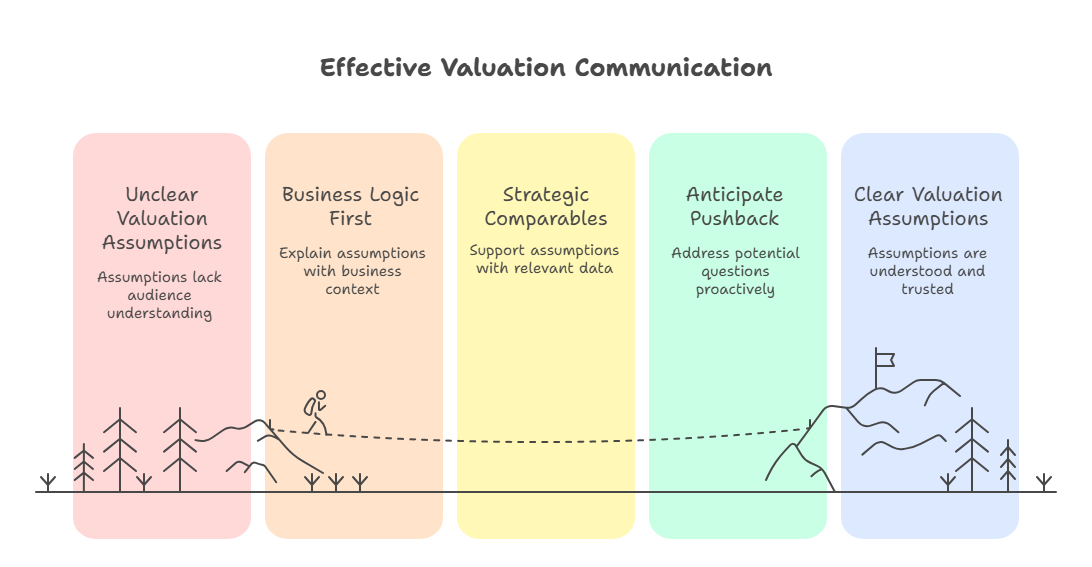
When explaining assumptions, don’t lead with the number—lead with the story behind it.
Instead of saying,
“We used a 9.5% WACC,”
say,
“Given our low customer churn, recurring revenue base, and no long-term debt, we applied a 9.5% discount rate, which is slightly below the industry median.”
This tells the audience why the assumption makes sense before they have a chance to challenge it.
If you’re not sure how your inputs stack up to benchmarks, Fin-Wiser’s financial advisory work includes market comparisons to validate things like cost of capital, margin growth, and terminal values.
Use Industry Comparables Strategically
Backing up your inputs with relevant data makes your model harder to dismiss. For example:
If you’re projecting a 30% EBITDA margin, show a peer group with similar margins.
If you’re assuming a 3% terminal growth rate, point to long-term industry trends.
This isn’t about overloading with data—it’s about choosing the 2–3 data points that give your valuation communication credibility.
These types of references are already embedded in Fin-Wiser’s DCF templates, which makes it easier to align your model with investor expectations.
Anticipate the Pushback
You already know what people will question:
“Is this growth rate realistic?”
“Why is your discount rate so low?”
“Isn’t your margin expansion too aggressive?”
So address those points before they come up. Acknowledge the risk, then explain how you’ve accounted for it in your model—either through conservative assumptions, scenario planning, or supporting data.
If you’ve never walked through your pitch with a critical eye, we do this regularly with clients through Fin-Wiser’s services—helping teams bulletproof their numbers before facing investors or boards.
Explaining assumptions isn’t about technical precision—it’s about making people believe that your numbers are reasonable, thought through, and tied to reality.