

Few companies have reshaped their industry—and their business model—as dramatically as Netflix. From its early days mailing DVDs in red envelopes to becoming a global leader in subscription-based streaming, Netflix’s evolution is more than just a tech success story. It’s a masterclass in how bold pivots require equally bold changes in how we assess business value.
Traditional valuation methods like earnings multiples or book value fall short when applied to a company that reinvests billions into content, expands aggressively across borders, and monetizes its user base through multiple pricing tiers. That’s why professionals rely on discounted cash flow (DCF) valuation to uncover the real worth behind Netflix’s long-term strategy.
Unlike static metrics, a well-built DCF model captures the core economics of transformation—how Netflix’s subscriber growth, average revenue per user (ARPU), content spend, and international expansion influence future cash flows and risk-adjusted returns.
For finance professionals, getting this right requires more than spreadsheets—it takes structured frameworks, dynamic forecasting logic, and automated valuation tools. That’s where Fin-Wiser comes in. Our financial modeling templates are designed specifically for modern business models like Netflix’s:
Subscription-based revenue
Content-heavy CapEx
Variable churn and growth rates
Terminal value modeling with real sensitivity analysis
Whether you’re modeling a media platform, SaaS company, or infrastructure project, Fin-Wiser equips you to build DCF valuations that stand up to scrutiny and support confident decisions. Our templates let you focus on insight, not formulas—empowering teams to value innovation, not just past performance.
In this blog, we’ll break down the Netflix business model, walk through a real-world DCF case study, and explain how to overcome the unique challenges of subscription valuation. By the end, you’ll understand what separates simple spreadsheets from investor-grade valuation models—and how to build your own using Fin-Wiser’s tools.
Breaking Down the New Netflix Business Model
To understand how to model Netflix using a discounted cash flow (DCF) valuation, we must first dissect its modern business model. Netflix is no longer a tech novelty—it’s a content-producing, globally scaling, data-driven subscription machine. But under the hood, it’s also a capital-intensive, margin-sensitive, and competition-heavy business.
Core Revenue Drivers: Subscriptions, ARPU, and Tiered Monetization
Netflix’s revenues come primarily from its monthly subscription model, which now includes multiple pricing tiers—basic, standard, premium, and ad-supported. Each comes with a different average revenue per user (ARPU), user experience, and churn profile.
To model this correctly, you need to:
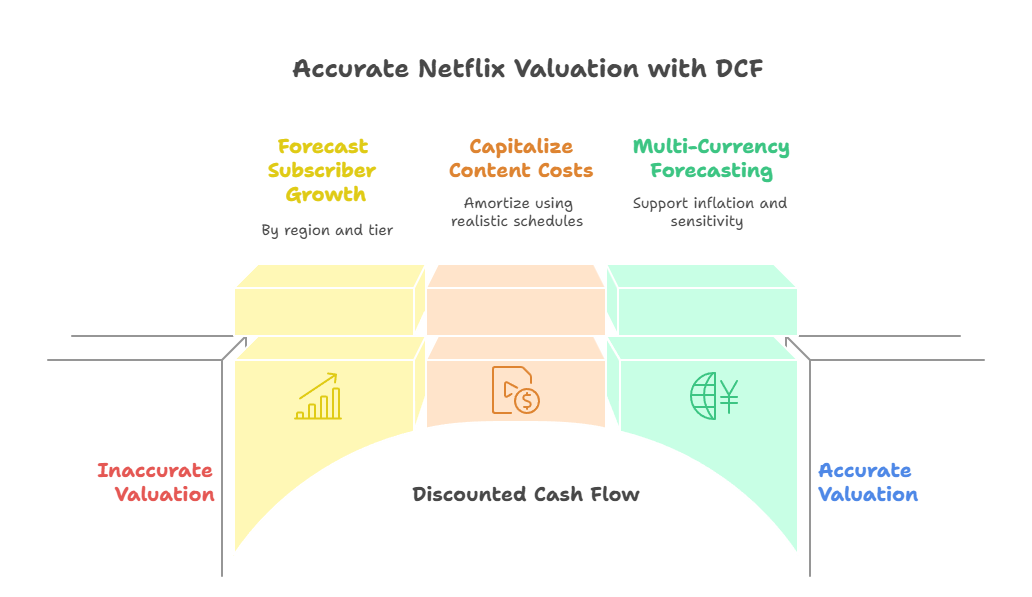
Forecast subscriber growth by region
Apply different ARPU levels for each plan
Factor in upgrades, downgrades, and churn
Adjust for pricing power and inflation
With Fin-Wiser’s financial modeling templates, you can separate revenue assumptions by tier and geography, making your forecasts realistic and investor-ready.
Key Cost Drivers: Original Content Production and Tech Infrastructure
Netflix’s dominance is fueled by its original content investment, with annual spend exceeding $17 billion. But content creation is not a typical operating expense—it involves:
Upfront CapEx-like outlays
Amortization over viewership lifecycle
Write-down risk for underperforming titles
This unique treatment of content costs makes Netflix a hybrid between a tech platform and a studio—which adds complexity to any DCF model.
To model this, you must:
Capitalize original content costs on the balance sheet
Amortize them using realistic schedules
Include future content obligations in cash outflows
These nuances are already built into Fin-Wiser’s modeling tools, especially those designed for media, SaaS, and project-based businesses.
Global Expansion, FX Risk, and Platform Economics
Netflix operates in over 190 countries, making it a rare example of a truly global subscription platform. This creates new modeling considerations:
Currency fluctuations affecting international ARPU
Regional licensing deals and compliance costs
Localization spending and content subtitling/dubbing
Variable market maturity (e.g., US vs. India or LATAM)
A modern DCF model must adapt to these layers without breaking the structure. Fin-Wiser’s templates support multi-currency forecasting, inflation assumptions, and sensitivity analysis across geographies—ensuring your valuation reflects real-world complexity.
Why Traditional Valuation Methods Fall Short
Netflix’s reported earnings often understate or misrepresent its economic value due to:
High non-cash amortization
Front-loaded CapEx
Nonlinear subscriber growth
This is why discounted cash flow modeling is not just helpful—it’s essential. A proper DCF model can isolate Netflix’s true free cash flow, adjust for risks, and value its long-term monetization capacity far better than a P/E multiple ever could.
With Fin-Wiser’s advanced templates, you can capture all of these dimensions in a clean, efficient structure—ready to support investment decisions, board presentations, or acquisition analysis.
Advanced DCF Framework for Subscription-Based Models
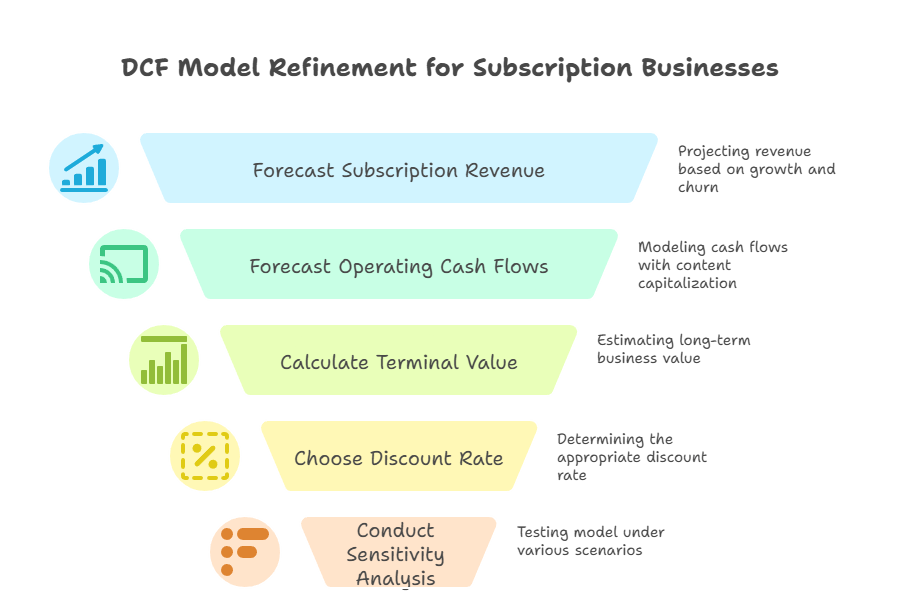
Valuing a subscription-based business like Netflix demands more than standard valuation logic. The nature of recurring revenues, customer churn, and front-loaded content investment requires a customized discounted cash flow (DCF) framework that captures how value is truly created—and where risk lives.
Let’s break down the core components of building a realistic, forward-looking DCF model tailored for streaming platforms and other recurring revenue businesses.
1. Forecasting Subscription Revenue: Growth, ARPU & Churn
In a subscription valuation, your top-line revenue is not a simple sales projection—it’s a function of:
Subscriber Growth: New acquisitions minus churn
Churn Rate: The monthly/annual percentage of customers canceling
Average Revenue Per User (ARPU): Changes with pricing tiers and regional strategies
Acquisition Costs: Marketing and content required to drive new sign-ups
Fin-Wiser’s financial modeling templates allow you to input all of these drivers as separate variables—giving you transparent, data-driven revenue forecasting logic that adjusts automatically when you test different scenarios.
Example: If churn increases by 2% or ARPU drops $1/month, Fin-Wiser’s dynamic cash flow module instantly updates revenue, EBITDA, and net present value (NPV)—so you can understand real business impact in seconds.
2. Forecasting Operating Cash Flows with Content Capitalization
Most tech companies expense R&D or marketing. Netflix, however, capitalizes its content investments, which are amortized over time based on viewership. This makes cash flow modeling tricky unless you structure it correctly:
Capitalize original content cost as non-current assets
Amortize content over 3–5 years using straight-line or consumption-based schedules
Reflect write-offs for underperforming titles
With Fin-Wiser’s templates, you can separate content CapEx from operating costs, amortize them according to business logic, and adjust free cash flows automatically—resulting in a much more accurate DCF case study.
3. Terminal Value: When Does Netflix’s Growth Settle?
Calculating terminal value in a high-growth subscription model is always a judgment call. For Netflix:
Use Perpetuity Growth Method with a conservative rate (2–3%)
Or apply an Exit Multiple based on forward cash flows or EBITDA
Be cautious not to overvalue long-term growth in saturated markets
Fin-Wiser’s financial models let you test both methods side by side, with sensitivity toggles to see how a 0.5% shift in terminal growth or discount rate affects your valuation outcome.
4. Choosing the Right Discount Rate (WACC)
Subscription platforms like Netflix face mixed capital costs—tech companies typically rely on equity, while content producers may carry debt. Your discount rate should reflect:
Cost of equity (via CAPM)
Content financing structure
Country risk for international revenues
Industry-specific volatility
With Fin-Wiser, you can calculate a defensible Weighted Average Cost of Capital (WACC) with country-specific risk premiums, sector beta inputs, and tax shields—all built into a single tool.
5. Sensitivity and Scenario Analysis
No DCF valuation is complete without stress testing key drivers. In Netflix’s case, model impact for:
Slowing subscriber growth
Escalating content costs
Rising interest rates
Currency depreciation in key markets
Using Fin-Wiser’s scenario planner, you can model base, upside, and downside cases to show how valuation shifts under different strategic realities. This kind of analysis builds investor confidence and makes your model decision-grade.
Netflix DCF Case Study: Realistic Assumptions, Real Implications
Let’s now put all the theory into action with a realistic DCF case study for Netflix. This section demonstrates how a detailed, assumption-driven discounted cash flow model can bring transparency and credibility to even the most complex digital platform valuation.
With a business as dynamic as Netflix—where content, technology, and global markets intersect—DCF offers a structured way to estimate intrinsic value and prepare for investor discussions. Here’s how to do it the right way.
📌 Key Model Assumptions
Subscriber Base:
Current: ~260 million global subscribers
Forecast Growth: 6% CAGR for the next 5 years, tapering to 2% long term
Average Revenue Per User (ARPU):
Global blended ARPU: ~$14/month
ARPU projected to grow by 2% annually, due to pricing strategy and tier optimization
Churn Rate:
Steady-state annual churn: ~30%
Managed via content personalization, pricing innovation, and ad-tier engagement
Content Spend:
Annual content investment: ~$17 billion
Forecasted to grow at 10–12% annually, driven by global originals and franchise expansions
Operating Margin:
Current: ~18%
Targeting expansion to 22–24% as scale and production efficiency improve
WACC:
Estimated at 8% (reflecting global exposure and tech volatility)
Terminal Growth Rate:
Assumed at 3%, accounting for maturity in developed markets and expansion in emerging regions
📈 Cash Flow Forecasting
Using these assumptions, projected free cash flows for the next 5 years are modeled based on:
Revenue = Subscribers × ARPU × 12
EBITDA = Revenue × margin
Deduct: content amortization, CapEx, taxes
Add: working capital adjustments and tax shields
Projected free cash flow to the firm (FCFF) ranges:
Year 1: ~$7.5B
Year 5: ~$12.8B
With Fin-Wiser’s templates, this process becomes seamless—inputs are structured, formulas are dynamic, and financial statements are automatically integrated.
💰 Terminal Value and NPV Calculation
Terminal Value (Perpetuity Growth Method):
Final Year FCFF: $13.3B
TV = $13.3B × (1.03) / (0.08 – 0.03) ≈ $273.86B
Net Present Value (Enterprise Value):
Sum of discounted FCFF over 5 years + discounted terminal value
NPV ≈ $220B–$230B, depending on ARPU and churn scenarios
This aligns closely with Netflix’s recent equity market cap, providing validation that a well-built DCF model can track real-world valuation even in fast-moving sectors.
📊 Sensitivity Analysis: Understanding Risk Exposure
What happens when one lever shifts?
+1% WACC → Valuation drops by ~$25B
+10% churn → $18–22B decrease in NPV
Flat ARPU (no growth) → NPV falls below $200B
Slower content amortization → Temporarily boosts cash flow, raises red flags with analysts
Fin-Wiser’s scenario toggles and automated sensitivities help model these risks on-the-fly—without needing to rebuild sheets from scratch.
🎯 Strategic Interpretation
This analysis shows that Netflix’s intrinsic value is driven less by short-term profits and more by:
Subscriber lifetime value
Sustainable ARPU growth
Content productivity
Efficient churn management
A weak DCF ignores these factors. A well-structured model—like the ones you can build with Fin-Wiser—brings these levers into full focus.
Strategic Takeaways for Modelers and Investors
The Netflix case study offers more than just a valuation number—it delivers critical insights into what it takes to model and evaluate modern digital businesses. Whether you’re an analyst, founder, investor, or project finance professional, here are the key lessons and strategic implications drawn from building a real-world DCF valuation for a subscription giant like Netflix.
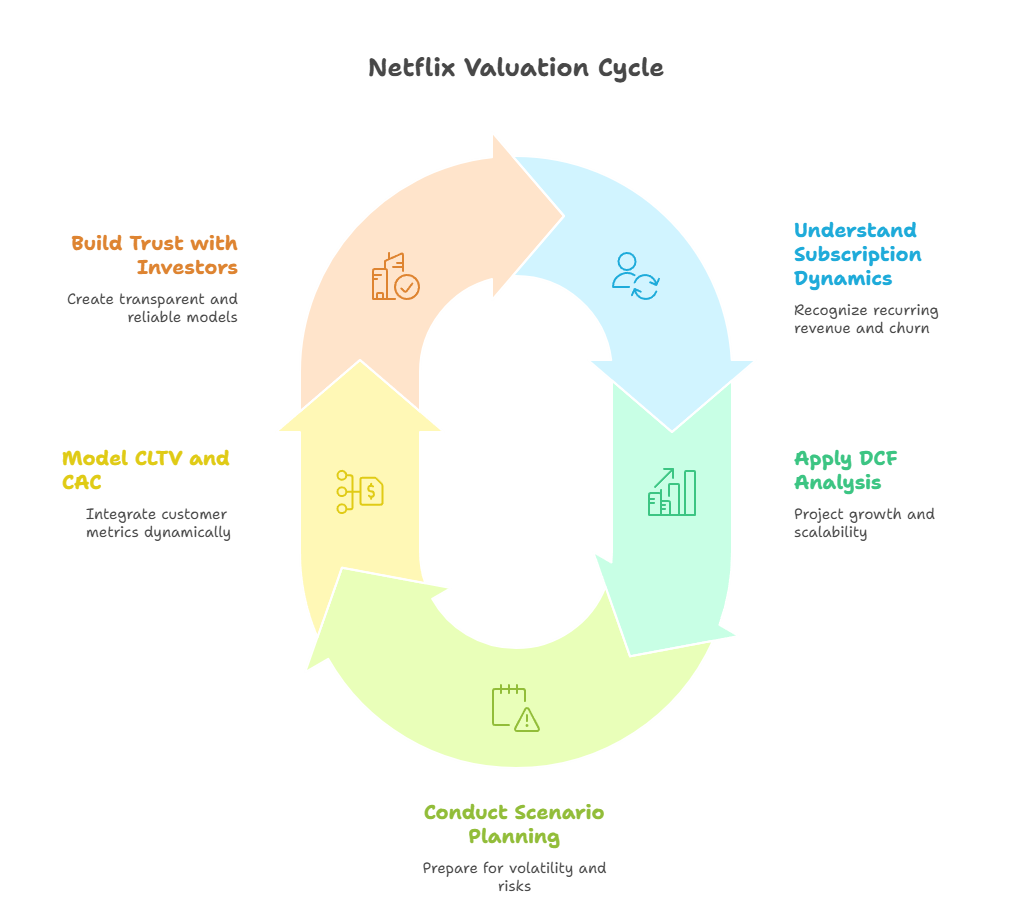
1. Subscription Valuation Is a Different Discipline
Unlike traditional businesses where revenue is driven by one-time sales, subscription models like Netflix rely on:
Recurring revenue streams
Churn mitigation strategies
Customer lifetime value (CLTV)
Your discounted cash flow model must be built around these dynamics. Treating a subscription business like a product-based firm leads to mispricing, poor strategic forecasts, and flawed investor conversations.
Fin-Wiser’s financial models allow you to input churn, acquisition cost, tiered ARPU, and lifetime margin assumptions into a clean, scalable structure—turning guesswork into analysis.
2. DCF Unlocks Value That Multiples Miss
Valuing Netflix using earnings or EBITDA multiples? You’d miss the platform’s long-term growth potential, global scalability, and strategic reinvestment.
DCF analysis, on the other hand, brings to light:
Growth runway in emerging markets
Future monetization from ad-tiers or new content verticals
Margin expansion as infrastructure scales
Competitive moats built through IP and viewer data
With tools like Fin-Wiser, you’re not just plugging numbers—you’re projecting vision into structured cash flows.
3. Scenario Planning Is Non-Negotiable
If your model doesn’t test for things like:
A spike in churn
Regulatory risk (e.g., EU content quotas)
Rising content acquisition costs
Interest rate volatility
Then you’re not preparing for real-world conditions. Strategic decision-makers demand models that show not only the “best case” but also what happens when things go sideways.
That’s why every Fin-Wiser template includes:
Multi-scenario toggles
Sensitivity charts
Visual dashboards for investor-ready presentation
Explore Fin-Wiser’s models if you want to model volatility, not just optimism.
4. CLTV and CAC Must Be Modeled, Not Assumed
Many models reference customer lifetime value (CLTV) and customer acquisition cost (CAC) but don’t model them dynamically. That’s a mistake. These metrics drive valuation in businesses like Netflix, Spotify, and SaaS platforms.
Fin-Wiser’s approach makes it possible to:
Integrate CAC with marketing spend
Forecast CLTV with churn and ARPU variables
Link this into your cash flow and DCF structure
That’s how real investment-grade models work—and that’s how you speak the language of venture capital and institutional capital alike.
5. A Great Model Builds Trust
Investors don’t just back ideas—they back numbers they can trust. A clean, well-structured DCF model:
Wins confidence in boardrooms
Speeds up due diligence
Survives scrutiny from CFOs and credit committees
With Fin-Wiser, you build models that speak the same language as investors—giving you the confidence to pitch, negotiate, and close deals faster.
Conclusion
In the era of digital disruption and evolving business models, valuation is no longer a simple numbers game. It’s a strategic exercise—one that requires precision, clarity, and the ability to capture long-term value creation. Netflix’s transformation from a DVD rental business to a global subscription-based streaming platform shows how traditional metrics fall short—and how a structured, data-driven discounted cash flow (DCF) valuation can reveal the true worth of innovation.
A well-built DCF model doesn’t just project numbers—it tells a story. A story about growth, risk, reinvestment, and resilience. For subscription giants like Netflix and emerging digital businesses alike, DCF is the only way to integrate the nuances of customer retention, content amortization, platform scalability, and pricing dynamics into a valuation that stands up in boardrooms and investor calls.
But to get it right, you need more than spreadsheets—you need tools designed to reflect how real businesses operate today.
That’s where Fin-Wiser makes all the difference. Our financial modeling templates are crafted by finance experts for finance professionals. Whether you’re building a model for a streaming platform, a SaaS venture, or a large-scale infrastructure project, our templates:
Handle complex revenue logic like ARPU and churn
Automate free cash flow and net present value (NPV) forecasting
Include built-in tools for sensitivity and scenario analysis
Reflect industry-specific capital structures and risks
These aren’t just models. They’re deal-winning assets.
So if you’re ready to build valuation models that drive real decisions, impress real investors, and reflect real business potential, it’s time to leverage Fin-Wiser’s expertise.
👉 Start now with Fin-Wiser’s financial modeling solutions and transform how you model the future